
Child Cannot Tie Football Boot Laces: What Works
A boot that keeps coming undone is a kit problem, not a failing.
If your child cannot tie football boot laces, you can fasten the boot another way tonight and still teach the knot slowly, with no tying on the touchline.
For a long time I knelt at the back gate and re-tied the same lace three times a session, until a loose end caught on the other boot and my child sat down hard on the lawn. The boots were fine. The fastening was the weak point.

Four fastenings, four catches
No Tie Laces Football Boots: Four Ways to Fasten
If your child cannot tie football boot laces, you have four ways to fasten the boot without the knot: a lock on ordinary laces, elastic laces, a hook-and-loop strap or a laceless boot. Pick the one that goes on easily and stays put, then teach the knot separately in short, calm sessions away from the pitch. The NHS lists tying laces as something children are starting at around 6, and says all children are different (an NHS children's occupational therapy page on getting dressed). Whatever you choose, check the fastening before every session, because a loose lace on one boot is a trip hazard for the other foot.
A boot can stay on without your child tying anything, and each way trades something for the convenience. None of the four has been tested for children's football, so what follows is NHS and occupational-therapy advice (Somerset NHS, occupational therapist's guide, NHS Wales footwear advice).
| Fastening | What it solves | The catch |
|---|---|---|
| A lock or band on ordinary laces | The boot is the usual shape, so the choice is widest. | An adult fits it, it must suit the lace and the eyelets, and nobody has tested how well it holds in play. |
| Elastic laces with a sliding lock | Swap them in once and the boot slips on. Occupational therapists name them as an alternative to tying (occupational therapist's guide). | Set too loose the boot is baggy and set too tight it presses the top of the foot, so fit-check it. |
| A hook-and-loop strap boot | The easiest to fasten alone. NHS footwear advice accepts "laces or Velcro straps" (NHS Wales footwear advice). | Fewer designs, and grass and mud clog the hook-and-loop so it loses grip. |
| A laceless slip-on boot | Nothing to fasten at all. | Costs more (prices below), and NHS advice warns against slip-on shoes that make toes claw to hold them on (NHS Wales footwear advice). |
For a child who also needs thick, soft laces to learn on, ordinary laces with an elastic lock can do both jobs in turn. The Somerset page recommends soft, wide laces for learning (Somerset NHS).
Which studs suit your surface is a separate decision, covered in choosing your child's first football boots.
UK listings, 7 October 2026
Laceless Football Boots for Kids: What to Check First
Laceless kids' boots exist at UK retailers, and avoiding the knot does not need the dearest one.
As of 7 October 2026, hook-and-loop kids' firm-ground boots were listed at about £18 to £38 (a kids' hook-and-loop boot listing, a juniors' velcro boot listing). A boot with elastic laces and a touch-tape bar was listed at £20 (a kids' elastic-lace boot listing).
Search results listed a kids' laceless boot at about £65 (a kids' laceless boot listing at Next).
That price came from search results and may have changed, so treat it as a guide and check the live listing. The smallest kids' size on any laceless boot is something to check on the retailer's size filter before you fall for a colourway.
Before you buy a laceless boot, run through four checks.
- Check the smallest size offered before falling for a colourway, because a boot that starts above your child's size is no use.
- Try it on and pull it on and off yourself, so you know whether your child can manage it alone.
- Check the heel stays put when your child jumps and turns, because NHS footwear advice warns against slip-on styles where toes claw to hold the shoe on (NHS Wales footwear advice).
- Check the surface the boot is made for matches where your child plays.
Two minutes a day, backwards
Teach Child to Tie Boots: A Two-Week Routine
To teach a child to tie boots, work backwards. This is backward chaining. You do the early steps and your child does the last one, then takes over one step further back every few days, as an NHS occupational-therapy page and an occupational therapist both describe (NHS occupational therapy, occupational therapist's guide).
Practise with a boot or shoe on a table, in a calm moment, with soft, wide laces and, if you have them, two colours tied together at the ends (Somerset NHS, occupational therapist's guide). Nothing here is a tested programme, and NHS guidance says all children are different (NHS occupational therapy).
- 1
The practice boot. Put a boot or old shoe on a table with soft, wide laces, two colours if you can. Practise at a calm time, never at the gate before a session (Somerset NHS, occupational therapist's guide).
- 2
Days 1 to 3, the last pull. You make the whole bow except the final tighten. Your child pulls both loops tight and gets the credit.
- 3
Days 4 to 6, cross and post. You make the first knot and the two loops. Your child crosses the loops, posts one through the gap and pulls tight, the "bunny ears" way (Somerset NHS, NHS Wales leaflet).
- 4
Days 7 to 9, the loops. Your child now makes both loops as well, from a first knot you have tied.
- 5
Days 10 to 12, the first knot. Your child ties the first knot too. You only watch, and name the next step if they stall.
- 6
Days 13 to 14, the whole thing. The whole bow, boot on the table, then boot on the foot, finished with a double knot, which an NHS Wales leaflet says is more secure (NHS Wales leaflet).
Two minutes is plenty. If a step takes many tries, go back a step and call it normal.
Two weeks is a guide: many children need longer, and the NHS lists tying laces as a skill children are starting at around 6 (NHS occupational therapy). Until the knot is ready, use one of the four fastenings so football never waits on the lesson.
A doorstep check, then play
Football Boots for a Child Who Cannot Do Laces: Tie It Once
Whichever fastening you pick, check it once at the door rather than at the touchline. An engineering study of shoelace knots found that repeated impact plus swinging make a knot fail, so running loosens any knot sooner or later (a 2017 study of why shoelace knots fail). That study used knots and one adult runner, not children, so it is a reason to check, not a rule.
Short loops
Trim long laces or choose short ones so the loops end above the toe cap, not down by the studs where the other boot can catch them.
Double knot, then tuck
Finish with a double knot (NHS Wales leaflet), then tuck the loops under the lace crossings or into the tongue so nothing trails. The tuck is our own tip, untested.
Snug, not tight
Pull firm from the toes up, then check a finger slides under the laces at the top of the foot. NHS footwear advice says fit should be "snug" without excessive tightness (NHS Wales footwear advice).
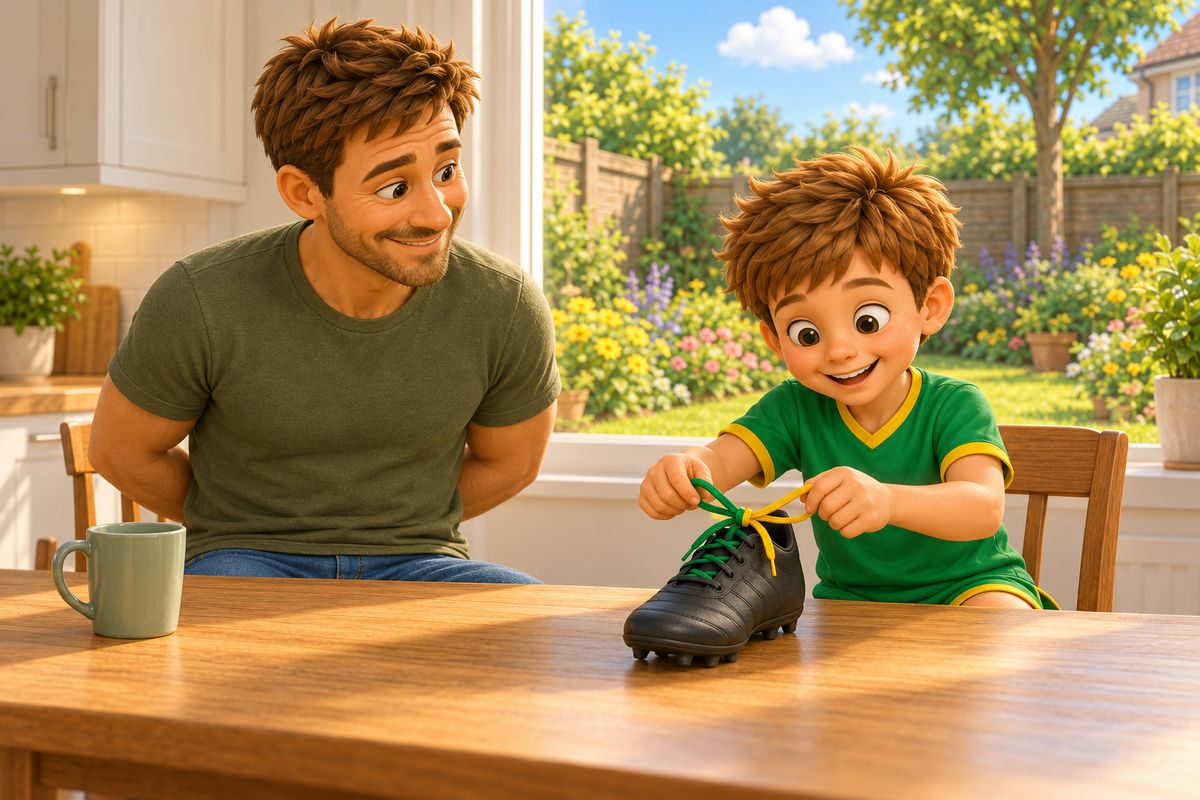
"Shall we do the boot check together, then play?"
If shin pads are the other fight at the door, see child refuses to wear shin pads. Before a club session, tell the coach how the boots fasten and ask whether a quick check at half time is fine. For what to expect on the day, see first football club session.
A calm signpost, not a diagnosis
When Tying Laces Stays Hard
NHS occupational-therapy guidance lists tying shoelaces as a skill children are starting at around 6, and adds "All children are different" (NHS occupational therapy). A Somerset NHS therapy service says difficulty usually comes from hand movements or from following the steps (Somerset NHS).
A plain reading: mention it to your child's GP, health visitor, school nurse or SENCO if weeks of easy practice change nothing, if buttons or zips are hard too, or if your child is upset or avoiding football over the boots. They can say whether an occupational therapist would help.
Asking is not a label, and it does not mean something is wrong. Neither NHS page says how many children are still not tying at a given age, so there is no number to give.
What is known and what is not
What the Sources Say About Laces and Boots
An NHS children's occupational therapy page on getting dressed lists starting to tie laces at around 6, says "All children are different" and teaches backward chaining. It is a dressing checklist, not research, and it says nothing about football.
The Somerset NHS therapy page on tying shoelaces advises soft, wide laces and practising with the shoe on a table, and an occupational therapist's guide to shoe tying describes elastic laces with a sliding lock and backward chaining. Both are written for shoes in general with no studies cited, and neither says an elastic lock suits football.
An NHS Wales leaflet on tying shoe laces says a double knot is more secure. The document itself is dated 2014, although its web address says 2020, so it is an older leaflet and was not tested against running.
NHS Wales footwear advice for children from February 2024 says boots or shoes should be fastened securely, preferably with laces or Velcro, and warns against slip-ons that make toes claw. It is about everyday shoes, not football boots or laceless boots.
A 2017 study of why shoelace knots fail, in the Proceedings of the Royal Society A, found repeated impact plus swinging make a knot fail. It filmed one volunteer runner, took accelerometer readings from a volunteer and tested knots on a pendulum rig, and it had no children.
The prices in the laceless section come from four retailer pages seen in search results. None could be opened, so they are indicative only.
No study found tests any of these fastenings for children's football, or says when a child should be able to tie laces, so this page offers a sensible order, not a proven fix. I would rather say the routine is a sensible default than pretend a study picked it.
Quick answers
Common Questions About a Child Who Cannot Tie Football Boot Laces
Why can my child not tie football boot laces?
Tying is a two-handed, multi-step skill, and an NHS occupational-therapy page lists starting to tie laces at around 6, with all children different (NHS occupational therapy). A Somerset NHS page says difficulty comes from hand movements or following the steps (Somerset NHS).
Are there no tie laces football boots?
Yes, in four forms: a lock on ordinary laces, elastic laces, hook-and-loop strap boots and laceless boots. Each has a catch, set out in the table above. None has been tested for children's football (occupational therapist's guide, NHS Wales footwear advice).
Are laceless football boots for kids worth it?
Search results listed one at about £65 on 7 October 2026. Check the smallest size and try the boot on so you know your child can pull it on alone (a Next listing). A strap or elastic-lace boot listed from about £18 to £38 does the same job (listing, second listing, third listing).
Is a slip-on boot safe for my child?
No standard specific to children's football boots was found. NHS footwear advice prefers laces or Velcro and warns against slip-ons that make toes claw, so check the heel holds and the toes are not gripping (NHS Wales footwear advice).
How long does it take to teach a child to tie boots?
Two weeks is a guide: two minutes a day, backwards from the last pull (NHS occupational therapy, occupational therapist's guide). Many children need longer. Go back a step whenever it stalls.
Should I tie their boots for them?
Yes, before each session, with short loops and a double knot tucked in. Teach the knot at a calm time, not at the gate.
Keep going
Where to Go From Here
Three places to go next, depending on what the doorstep looked like.
Still choosing the boots?
Astro or firm ground, studs and fit: the buying side of the decision.
Choose the bootsShin pads the other fight at the door?
Fit, style and one calm rule so the pads stay on.
Sort the shin padsWant more kit answers?
Boots, shin pads and the other kit questions in one place.
See Kit, Rules & SafetyTonight's five minutes
Fix the fastening before the next session.
Check the boots on the doorstep: a lock or strap, or a short double knot with the loops tucked in. Then give two minutes to the last pull of the knot and stop there.