Is the first session still ahead of you?
What usually happens on the day, and one familiar game to play at home first.
Read about the first session
A crying child at training is not a failed child.
If your child cries at football training and will not join in, stay close at first, then step back a little at a time as your child settles. Have a quiet word with the coach before the session starts. Say goodbye briefly once your child is ready, and never slip away unannounced.
England Football's own advice is that a first session "can be a big step for children and adults" and that you should speak to a coach on arrival (England Football's welcome page for new families). If it is still upsetting after a few goes, pause for a few weeks and try again.
For a long time I tried to peel my child off my leg at the touchline and walk off with a cheerful wave. It never worked, and the car park afterwards was worse than the pitch. What helped was staying on the grass for the first few sessions and moving back one step at a time.
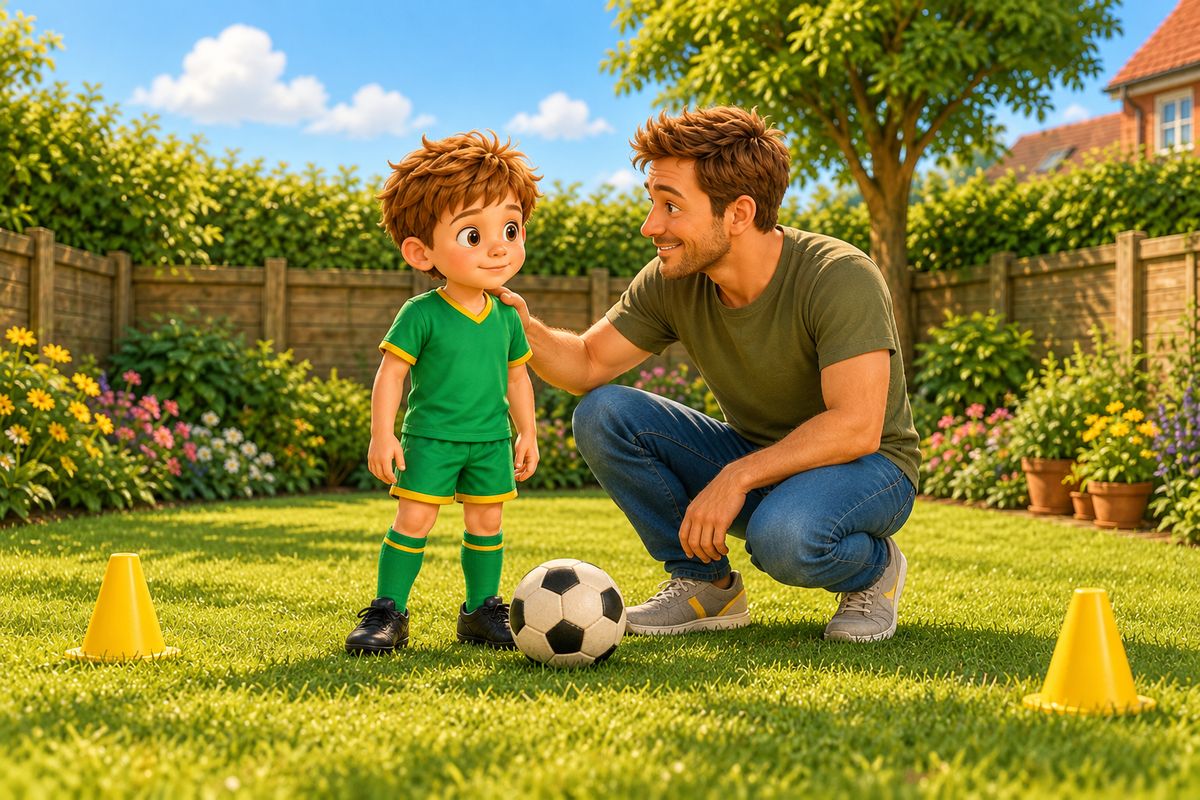
Watch the first ten minutes
A club session is a new place with new adults and new children, and a young child may find that a lot. England Football itself calls a first session "a big step for children and adults" (England Football's welcome page for new families).
An NHS trust describes separation anxiety as "the fear of being away or separated from a parent or carer" (an NHS trust's advice on helping a child with anxiety). Many crying children will simply be finding a new place hard rather than having anything to diagnose. These are my readings, and none has been tested as a cause for football sessions.
| What you see | What it may be | First thing to try |
|---|---|---|
| Holds your hand or leg and will not step onto the pitch | A new place, and you are the one familiar thing. | Rung 1: stay beside your child and join in if they will. |
| Cries when you move away, then settles | The goodbye is the hard part, not the football. | Rung 3: a short, same-every-time goodbye (a children's mental health charity on separation). |
| Stands at the edge watching and shakes their head | Working out what happens before joining in. | Tell the coach on arrival, then rung 1: let watching count (England Football). |
| Cries after a miss, a knock or being told off | The upset is about the moment, not the club. | Say less, stay close and use the scripts further down. |
| Cries only at some sessions | Tired, hungry or a long day. | Check snack, drink and timing before the next session. |
Pick one row per session, because a child given five fixes gets none. The table is a spotting aid, not a diagnosis, and "I don't know" is a fair answer.
If your child is fine until the match starts and then freezes, see child stands still in football matches.
Four rungs, one at a time
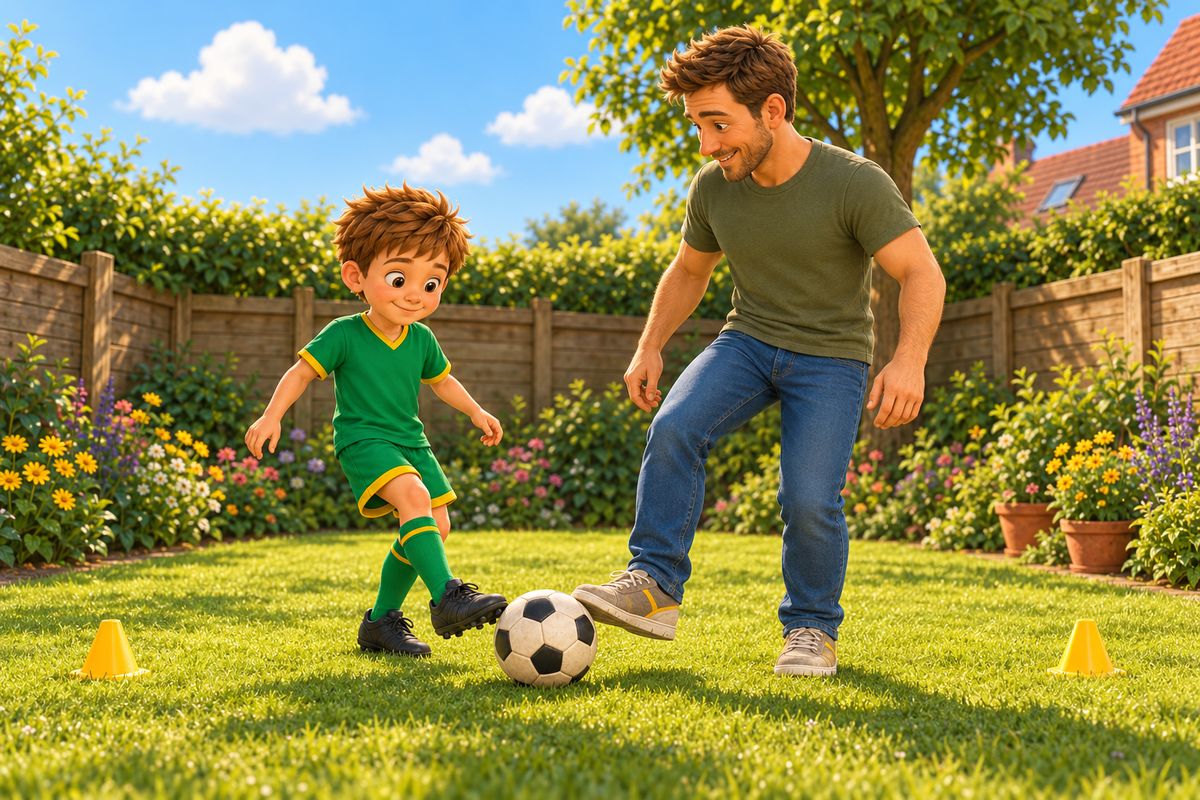
Advice on this differs. One activity provider goes further than most: "The worst thing you can do as a parent is stay and try and make the child feel better" (an activity provider's view on leaving quickly). A children's mental health charity advises brief goodbyes and practising separations gradually (a children's mental health charity on separation).
An NHS trust warns that avoiding a fear can reduce anxiety in the short term but makes it harder in the long term, and suggests small steps (an NHS trust's advice on helping a child with anxiety). The plan below follows the small steps and ends in a quick goodbye like the first view. It is my arrangement, not a tested programme.
Ask the club whether parents are expected to stay on site, because rules vary. The plan keeps you in sight of your child at every rung.
Before rung 1, and only once, meet the coach. Arrive 10 minutes early, introduce your child by name, and say in one line what helps. England Football says clubs usually begin with introductions and fun activities (England Football's welcome page). This is a one-off, not a rung, so it does not wait for anything.
Stay beside your child. Stand or sit next to them for the whole session, and join the warm-up if they will. No pushing, no "go on". Watching counts.
Move to the edge. Pick the same spot every session, a few steps from the activity but in clear sight. Say where you will be.
Say a short goodbye. Use the same ritual each time: "I'll be over there where you can see me. High-five, then I'm back at the end." Then step back and stay on site and in view. Keep it brief, because dragging it out tends to make it harder (a children's mental health charity on separation).
Watch from further away. Move to the side of the pitch, still where your child can see you and the coach can find you, and be back at the end when you said.
Move up a rung when your child has gone two sessions in a row without crying at the current one. Move back a rung, or stop for the day, if they become upset, and call it normal.
If you do not want to take the slow route, the quick-exit view is a real option for some families. The safe version is still a brief goodbye while telling the coach, never a slip-away. Nothing here is a tested programme.
Say less, say it kindly

A child who is upset hears little of a long explanation. A calm, honest sentence works better than a promise you cannot keep, so be honest about when you will be back (a children's mental health charity on separation).
"Shall we just watch the first bit, and you tell me when you want to try?" Let the answer be yes to watching.
"I'll be over there where you can see me. High-five, then I'm back at the end." Same words, same high-five, every time.
"You stayed, and that was brave. Shall we come again on Saturday?" Praise the staying, not the football.
To the coach: "My child finds new places hard at first. Could you say hello by name, and let them watch for a bit?"
Coaches usually welcome this. England Football says "don't be afraid to speak to a coach or volunteer when you arrive" (England Football's welcome page). Have the chat away from your child.
Stop saying "don't be silly", "everyone else is fine" and "you'll be embarrassing me". None has been tested and all add worry.
A pause is not quitting
Settling a nervous child into football training can take several sessions, and a pause of a few weeks is a normal option. Going back is not a failure, and leaving a rough session early is fine.
A parenting article on a child who does not want to play advises finding out calmly what is wrong and, once you have committed to a block, seeing it out. This page softens that: ask your child, and treat it as a decision for your family. That is one author's view with no evidence cited.
Think about a pause if your child cries hard at every drop-off for several sessions in a row, is upset for a long time after you have left, or has started to dread football.
Leave it for two to four weeks, keep a kickabout going at home (see the home game on the first football club session page) and try one trial session again.
An NHS trust says to speak to your GP if symptoms are "interfering significantly with their day-to-day life" (an NHS trust's advice on helping a child with anxiety). If the crying spreads beyond football, say so to your GP or health visitor.
If your child says they want to stop altogether, see child wants to quit football.
What is known and what is not
England Football's welcome page for new families says a first session can be "a big step for children and adults" and that clubs usually begin with introductions and fun activities. It is a welcome page, with nothing about a child who cries or whether a parent should stay.
An NHS trust says avoiding a fear can reduce anxiety in the short term but make it harder in the long term, and suggests small stages. It is general child-anxiety advice, not about sport, and a child who cries at football may not have an anxiety problem at all.
A children's mental health charity recommends brief goodbye rituals and practising separations in small steps, while an activity provider recommends a quick exit. Both are expert opinion, mostly about school and activity classes, with no trial behind them, and they disagree on staying. The plan tries to work with either.
A parenting article says a new environment can cause fear and to find the problem calmly. It is one author with no evidence cited.
I looked for a study of children who cry at football sessions and did not find one, so everything here is advice, not a result.
Quick answers
A club session is a new place with new adults, and England Football calls a first session "a big step for children and adults" (England Football). That is the likely reason, but it is my reading and not a tested finding.
Views differ. One provider says leave quickly (activity provider), while a children's mental health charity says keep goodbyes brief and practise gradually (children's mental health charity). Stay close first, tell the coach, and step back one rung at a time.
Stay beside them and let watching count. Meet the coach, then move to the edge of the activity when your child is ready (England Football, NHS trust).
Use one short ritual, such as a high-five, every time, and tell your child when you will be back (children's mental health charity). Never slip away unannounced.
Speak to the coach on arrival (England Football), keep the same spot and goodbye each time, and praise staying. Give it a few sessions before you decide.
If every drop-off is hard for several sessions or the upset lasts after you leave, pause for a few weeks. Speak to your GP if it is interfering significantly with daily life (NHS trust).
Keep going
Three places to go next, depending on what you saw.
What usually happens on the day, and one familiar game to play at home first.
Read about the first sessionA wobble or a pattern, and how to ask without making it worse.
Read about wanting to quitMore calm, low-pressure ways in for a child finding their feet.
See Confident BeginnersTonight's five minutes
Choose a short goodbye line and a high-five, say them to your child tonight and write the one-line coach message on your phone. Use the same words at the next session.