
Want the full silent dribbling game this pairs with?
The named game this page's private first round is quietly borrowed from.
Play the silent dribbling challengeSome children don't dislike dribbling. They dislike being watched while they might get it wrong.
If your child hangs back from a dribbling game, freezes the second the ball reaches them, or won't even start unless nobody's looking, that isn't the same as disliking football. It isn't the same as being scared of the ball hitting them either, which is a different, adjacent page linked further down. It's the risk of a visible mistake in front of someone. Three small changes fix tonight's game: who's watching, what actually counts as a good go, and what gets said the second the ball gets away.

Two different fears, easy to mix up
A child who won't join in a dribbling game isn't automatically scared of football. Three different things can look almost identical from the outside, and mixing them up means fixing the wrong one.
The first is what this page is about: a fear of getting the touch wrong, losing control of the ball, tripping over it, or fumbling it in front of someone who's watching. The second is a fear of the ball itself, flinching or ducking away when it comes near their body, a different, physical fear covered properly on the sibling page about a child afraid of the ball. The third is the named silent dribbling challenge's own particular friction, two players arguing over whether a touch counted, a disputed sound call mid-game, which is a rules problem rather than a confidence one, and it's handled on that sibling page.
Naming the fear correctly is the first adaptation, because the fix for each one is different.
The single biggest lever
A child who feels watched tenses up before the touch even happens, and a tense first touch is more likely to go wrong, not less.
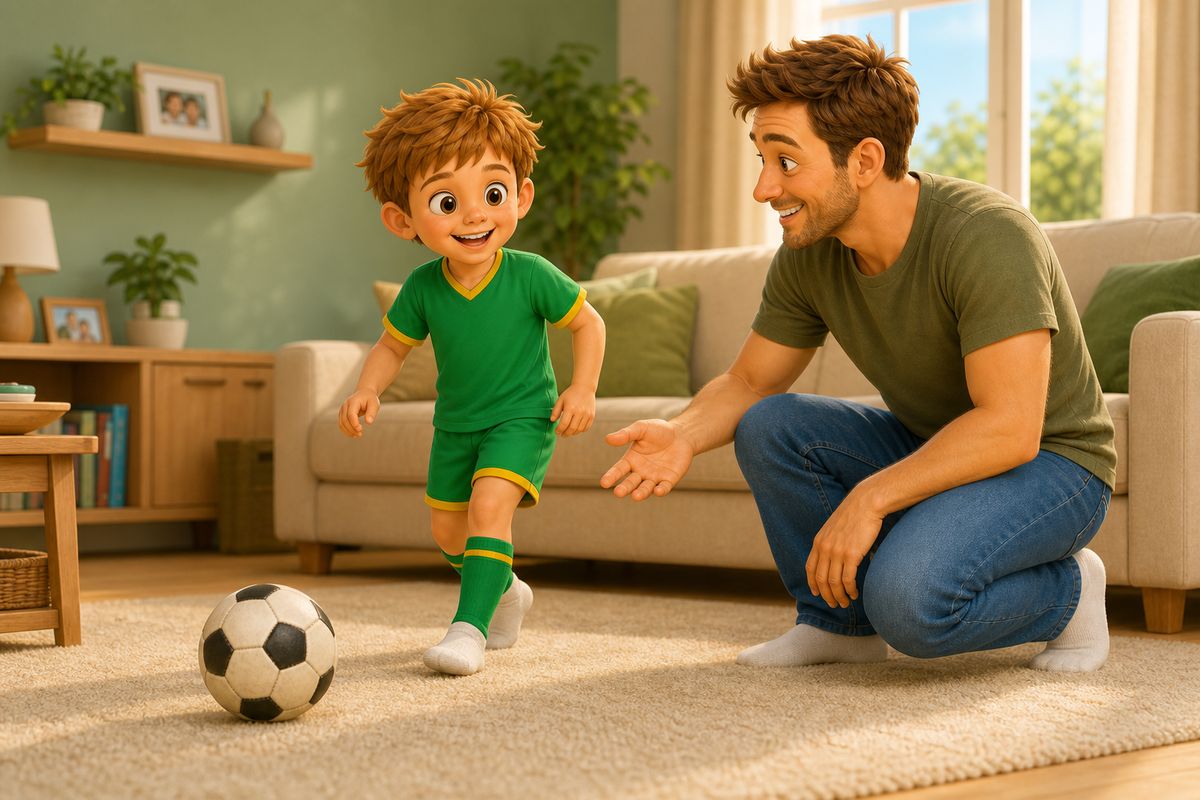
The concrete version: let the first few goes happen with you doing something else nearby. Fold washing, half-watch the television, potter with something in your hands, rather than standing over your child with your full attention fixed on the ball.
Try saying: "Shall we just have a kick about while I sort this washing? No need to show me anything."
A child who won't dribble past a watching parent will often do it happily the moment that parent's attention is visibly somewhere else.
Trying counts, not the outcome
Most dribbling games quietly reward keeping control of the ball, which is exactly the outcome a nervous child is afraid of failing at.
Reframe success as attempts made, not touches kept. Count how many times your child had a go, not how many they got "right". Skip corrections mid-attempt entirely, and save any technique note for a completely separate, calmer moment.
Decide the words in advance
Your own spontaneous reaction to a fumble, a wince, a sharp intake of breath, a "careful", reads as judgement even when you don't mean it that way.
Agree the reset line before you start playing: one flat, neutral phrase used every single time the ball gets away, so there's nothing left to react to in the moment.
Try: "Ball's away. Go again."
The reasoning, honestly stated
Removing the audience and redefining success both lower the cost of a visible mistake, and a lower-stakes attempt is one that actually happens, while a high-stakes one often doesn't. This isn't attributed to a single study here: two genuine searches turned up real research on fear of failure in football, but nothing narrowly fit an informal, one-on-one home game with a five to nine-year-old. It's stated plainly as parenting reasoning instead, rather than being stretched onto a citation it doesn't quite fit. The same underlying idea already sits behind this cluster's own "no fuss, no comment on the miss" instruction on the parent page and its "Mistake One" reset advice. See how Our Kickabout researches its pages.
Borrow the parent game, quietly adapted
Take the silent dribbling challenge itself, but play a private first round before any of its usual furniture, no listener role, no shared streak. Just your child, alone in the space, you not directly watching, counting nothing at all for the first few goes.
Only once that feels easy does the listener variant or a shared streak get introduced. Cross-links the parent page for the full version once your child's ready for it.
Which page matches tonight
This page is about a child nervous of getting the skill wrong, not a child afraid of the ball itself, which is a different page. It also isn't about two players arguing over a sound call mid-game, which is a different page too, despite the confusing overlap in wording. If either of those is closer to what you're seeing tonight, the routes below take you straight there.
Quick answers
Reduce how directly they feel watched, do something else nearby rather than staring, count attempts rather than success, and agree one flat reset line in advance so nothing about the moment the ball gets away feels like a verdict.
Fear of the ball usually shows as flinching or ducking away from contact, and that's covered on a different page. Fear of getting dribbling wrong usually shows as reluctance to even start, or visible tension the moment someone's watching, and that's this page.
One flat, neutral line agreed in advance, such as "Ball's away. Go again", said the same way every time. Avoid narrating the miss, even kindly, since a child who expects a comment starts playing for the comment instead of the game.
Keep going
Three pages sit right next to this one tonight, one to play, and two in case a different fear is the real one.
The named game this page's private first round is quietly borrowed from.
Play the silent dribbling challengeA different, physical fear, flinching or ducking from contact, with its own separate route in.
Read the fear-of-the-ball pageA three-phase routine for once the nervousness has eased and practice itself is the goal.
Try the quiet indoor sessionTonight's five minutes
Let the first few touches happen without your full attention on them. That's the whole adaptation tonight.