
Fancy grass instead of tarmac today?
Keep the ball in the garden turns the fence and hedge line into the point.
Read the boundary gameA driveway isn't really a garden substitute. It's its own kind of space, and once I stopped trying to make it behave like a garden, the games got a lot better.
Flat, hard, usually a bit narrow, sometimes with a car parked right in the middle of it, a driveway has a very different feel to grass. It's tempting to treat it as a slightly worse version of a garden. It isn't, and this page names three concrete games built for exactly this space: line dribbling, a wall or garage-door target, and an around-the-car slalom.
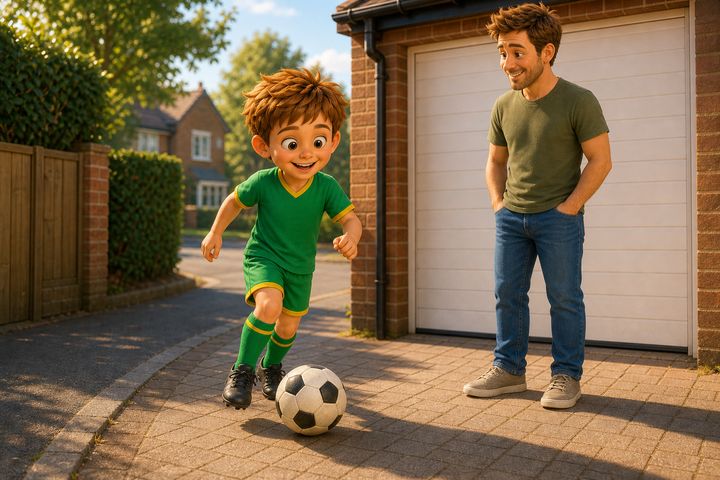
Flat and hard is a feature, not a compromise
The flat, hard surface means the ball behaves predictably, no odd bounces off tufts of grass, no getting stuck against a plant. That predictability is brilliant for control-based games, ones where the point is a clean, accurate touch rather than power. A clean touch here actually sounds different too: a crisp, flat contact rather than the slightly dulled thud of a mishit on grass, which makes it much easier for a child to feel the difference between a good touch and a rushed one.
It also tends to be a defined, obvious shape, a rectangle, basically, which removes the usual guesswork of marking out a course on an oddly shaped lawn. You can see the whole space at a glance and set a game up in seconds.
Use the edges you've already got
Use the natural edges of the driveway, or the gap beside a parked car, as your course. Dribble from one end to the other, staying within the space, then turn and come back. The predictable surface means your child can actually feel a clean, accurate touch here in a way that's harder on grass, which makes this a genuinely good place to build real ball control.
A target you didn't have to build
If there's a garage door or a decent stretch of wall at one end, that's your target, ready-made. Chalk a rough zone on it if you want more structure, or just aim generally and count clean hits. The flat surface means rebounds come back predictably too, so this doubles nicely as a two-person passing game if you stand a little back from the wall.
Turning an obstacle into the game
Don't see a parked car as blocking the space. Use it. Weave the ball around it, tight turns each side, and see how quickly a full lap can be done without losing control, or turn it into a timing challenge: see how many laps you can manage in a minute. This is one of those games that genuinely wouldn't work as well anywhere else, an obstacle that's slightly awkward to move around is exactly what makes it interesting.
No car on the drive today? Bins or a folded blanket work as a stand-in obstacle, the exact shape matters less than having something to turn tightly around.

The evidence, and the one rule to agree first
A study comparing soccer skill performance across playing surfaces found that youth players performed around 6% better on a more uniform, predictable surface than on grass or artificial turf, supporting the idea that a driveway's flat, hard surface rewards control-based games.
This was a small study, 14 boys with a mean age of 12.7, performing a structured passing test on an indoor sports-hall floor, not a domestic driveway and not younger children playing informally, so it's cited as evidence that a more predictable surface is linked to more accurate ball control in principle, not proof of the same measurable gain on any one driveway.
A driveway also earns its own place in this cluster, not folded into the garden pages, because it's a genuinely common UK space: around 65% of British households have, or could have, off-street parking for at least one car, per RAC Foundation research on English housing data.
See how Our Kickabout researches its pages.
Agree the rule before the first kick
Driveways are usually closer to a road than a garden is, so it's worth being more deliberate here than elsewhere about which direction the ball's allowed to travel. Confirm the boundary with the road clearly before starting, keep games facing away from it where the layout allows, and make sure anyone playing has suitable footwear. It's a short conversation, agreed once at the start, not something to work out after the ball's already halfway to the pavement.
Same cluster, different surface
The flat, hard surface is really the whole reason this gets its own page, it rewards a different kind of touch than grass does, which is why line dribbling and the slalom work so well here specifically. If your driveway backs onto a proper garden too, keep the ball in the garden and mini target shooting corners are worth mixing in on the days you fancy grass instead of tarmac.
Keep the ball in the garden turns the fence and hedge line into the point.
Read the boundary gameMini target shooting corners turns your garden's own corners into free targets.
Read the corner-shooting gameSmall Garden Games sorts every game in this cluster by what your space has.
Visit Small Garden GamesQuick answers
Line dribbling along the driveway's natural edges, a wall or garage-door target game, and, if there's a car parked there, a slalom weaving around it, all of which use the flat, hard surface's predictability instead of fighting against it.
Yes, with one clear rule agreed before starting: an agreed direction of play and a "ball goes toward the road, an adult retrieves it" rule, plus suitable footwear since hard surfaces are less forgiving than grass if anyone trips.
No, the opposite in some respects. A flat, predictable surface tends to reward a cleaner, more accurate touch than grass's odd bounces, which is exactly why control-based games like line dribbling suit a driveway well.
Tonight's five minutes
Pick whichever edge is free tonight, line-dribble it once, and see if a clean touch feels different on tarmac than it does on grass.