What was the foul?
What counts as a foul and the one-sentence difference between direct and indirect free kicks.
Read about fouls and free kicks
Yellow is a warning. Red means leave the game.
That is the whole idea, and it is all a child needs to follow a match on TV, with the reasons a referee might have for each card to add when they ask.
Two yellow cards in the same match make a red (Law 12 of the Laws of the Game). A referee shows a yellow for things like arguing, wasting time or a reckless challenge. A red is for very dangerous play, hurting someone on purpose or rude abuse.
I used to fumble this one when my child pointed at the telly and asked what the little card meant. Below are the reasons in child words, a script for the TV moment and a garden version where nobody is sent off.
For more kit and safety help, see Kit, Rules & Safety.
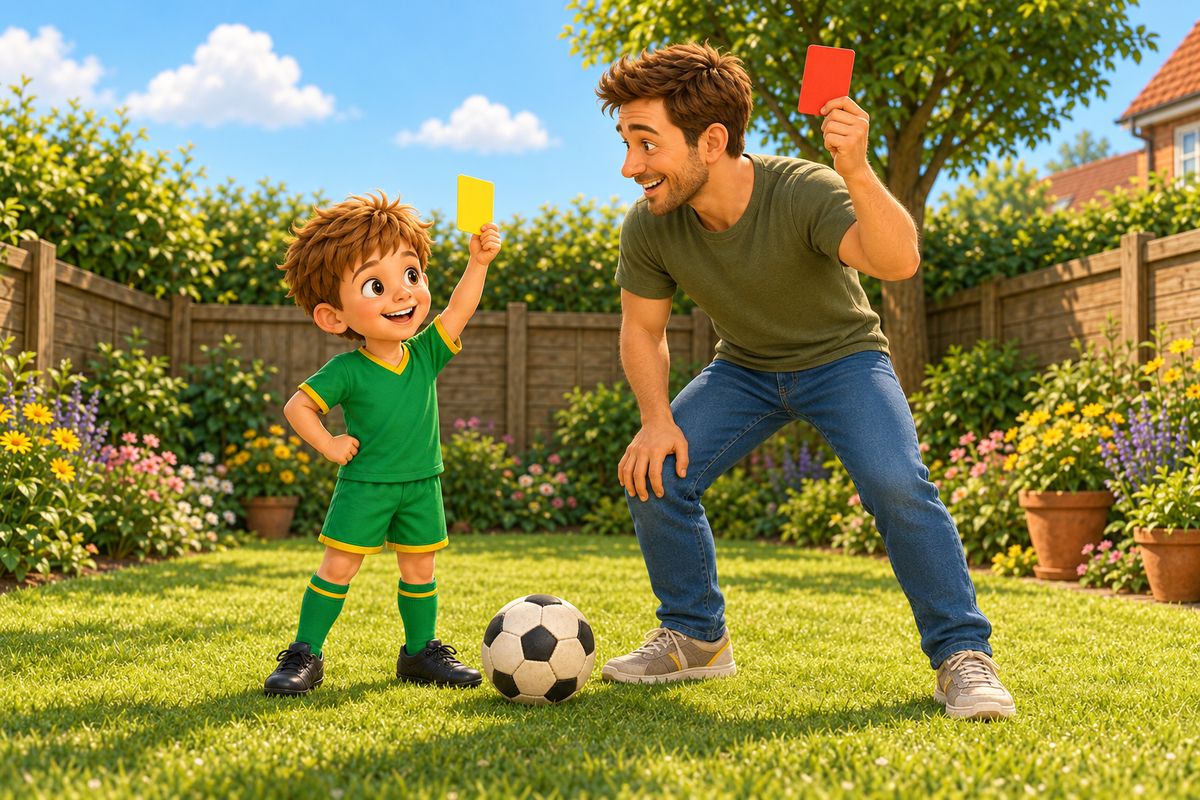
Two sentences a child can hold
In the Laws of the Game, the yellow card tells everyone a player has been cautioned, and the red card tells everyone a player has been sent off. A second caution in the same match is a red card (Law 12 of the Laws of the Game).
For a child, try this: "A yellow card is the referee saying 'careful, that was too much'. A red card means they have to leave the game."
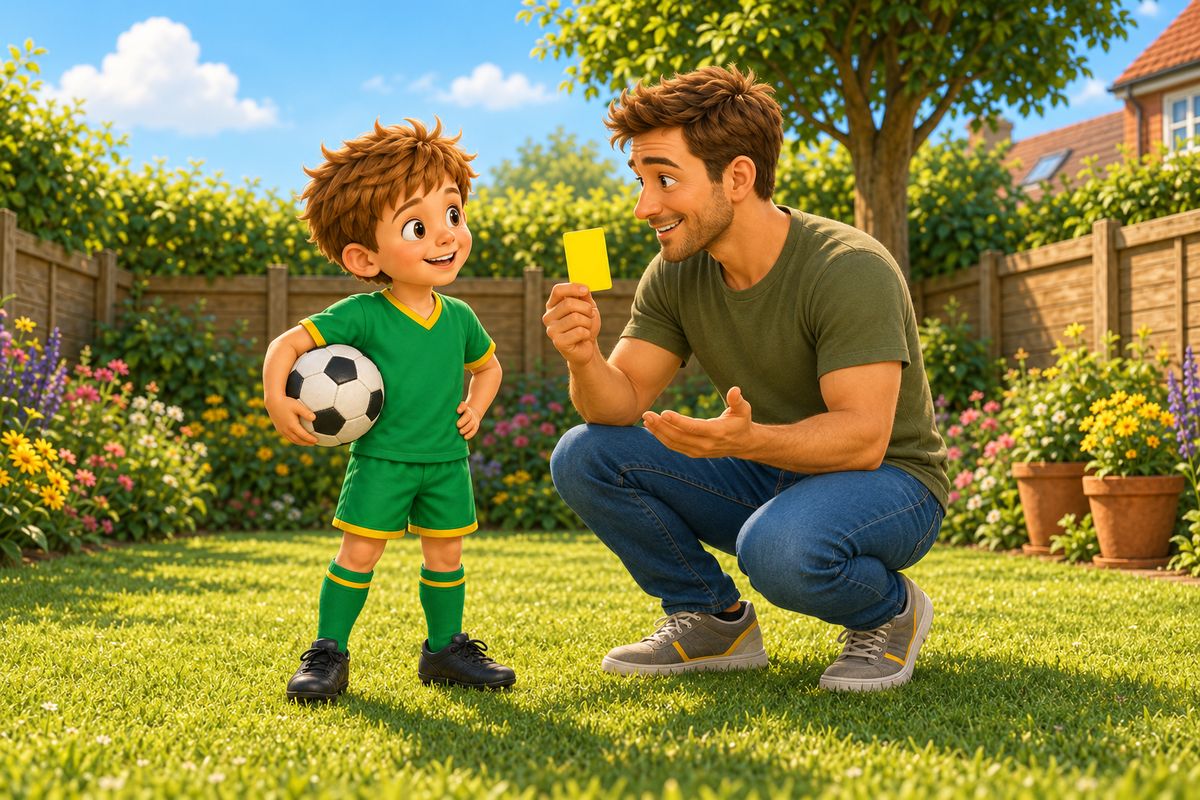
| Card | What it means | A child's version |
|---|---|---|
| Yellow card | A caution: a warning from the referee | "Careful, the referee has seen that." |
| Second yellow | Two cautions in one match become a red | "Two warnings and you're off." |
| Red card | Sent off for the rest of the match | "You have to leave the game." |
The Laws say that only a player, a substitute, a substituted player or a team official can be shown a card (Law 12 of the Laws of the Game). The crowd can shout all it likes and still never gets one.
Children's football can have its own rules. A club or referee will explain how cards work in your child's matches, so ask them if you are unsure.
The reasons, in kid words
The Laws list a good number of reasons for each card, but most fit into a few plain groups. The words below are a simplified reading of IFAB Law 12, and each item can be found in its lists.
| Card | Reasons, in child words |
|---|---|
| Yellow | Arguing with the referee. Wasting time. Stepping on or off the pitch without permission. Standing too close at a restart. Doing it again and again. A reckless challenge that does not look careful. Pretending to be hurt. Handling the ball to stop a promising attack. |
| Red | A very dangerous tackle (serious foul play). Hitting, kicking or fighting on purpose (violent conduct). Biting or spitting. Rude or abusive words or signs. Stopping a goal by touching the ball with the hands or by a foul. A second yellow. |
The Laws describe "reckless" as acting with disregard for the danger to an opponent, which is a yellow. Using excessive force and endangering an opponent's safety is a red (Law 12 of the Laws of the Game).
For what counts as a foul in the first place, see explaining fouls and free kicks. Handling the ball to stop a goal is one of the reasons, covered in why hands are not allowed.
This is a simplified reading of the Laws, so the referee's judgement on the day decides what a card is for.
Say it while it is happening
Explaining a TV decision with "that's unfair" leaves the conversation there. A better line is a question.
Try "Shall we guess what the referee saw?" or "What do you think the player did?" Both turn a moment of grumbling into a small guessing game, and your child gets to be the expert.
Referees make judgement calls, and sometimes even grown-ups disagree about them. It is fine to say so out loud, and it is fine to say "I'm not sure" too.
Keep the talk about the decision rather than the people. Nobody on screen needs a name for the idea to land.
The garden version
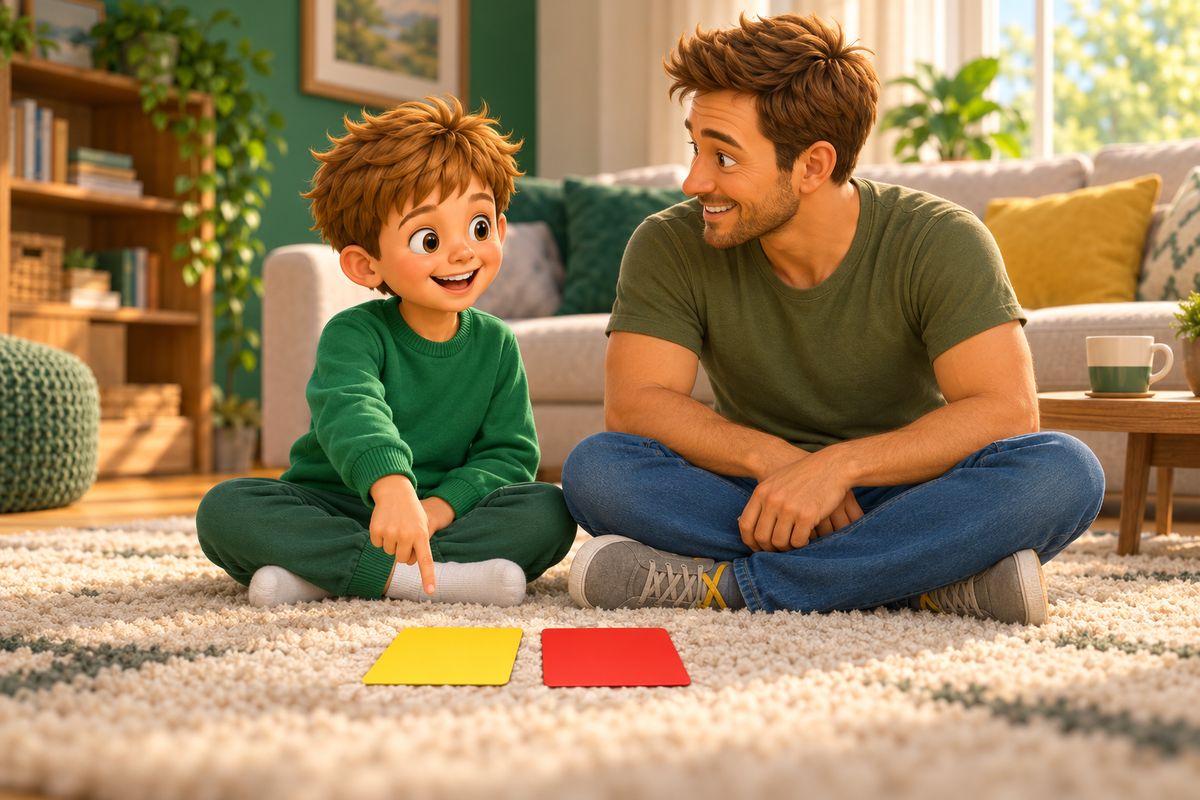
Our first garden red card ended the game, with one child in tears and one on the patio. We softened it the next day.
The real red card removes a player for the rest of the match. That is not fair or fun in a two-person garden game, so here is a softer version.
This is a home idea, not a rule from any source.
Make the cards. Two pieces of card, one yellow and one red.
Yellow means a reset. A calm 30-second pause, with one chance to say what they will do differently.
Red means a short break. A one-minute break, then straight back in. Nobody is out for the game.
Swap the referee. The child takes a turn holding the cards, and the adult can earn one too.
For games where nobody is ever sent out, see no elimination football games. For a general rule set, see simple rules to keep football fun.
What is known and what is not
Law 12 of the Laws of the Game sets out the offences that earn a caution or a sending-off, and the rule that a second caution in the same match is a red card. The FA's copy of Law 12 publishes the same Laws for England. Editions change by season, so check the current Laws.
The yellow card communicates a caution and the red card a sending-off. Only a player, a substitute, a substituted player or a team official may be shown one.
These are the rules for matches, not guidance for garden play. Referees apply them using judgement, so a child's question about one particular card can have more than one fair answer.
The garden version on this page has no source behind it. I made it up after a harsher first try at home went badly, and it has not been tested beyond our own garden.
Quick answers
A yellow card is a warning and a red card means leaving the game. Two yellows in a match become a red (IFAB). That is football cards explained simply.
For very dangerous play, violent conduct, biting or spitting, abusive language, stopping a goal by a foul or handball, or a second yellow (IFAB).
A player, a substitute, a substituted player or a team official (IFAB).
Only if you invent it. The version on this page is a short reset or a one-minute break, never leaving the game for good.
Cards tell players and spectators clearly what has been decided.
The Laws are the base, but clubs and age groups can have their own rules, so ask the club (The FA).
Keep going
Three places to go next, depending on what your child asks.
What counts as a foul and the one-sentence difference between direct and indirect free kicks.
Read about fouls and free kicksHandball in two questions a child can ask in play.
Read about handballFootball games where everyone stays in until the end.
Read about no-elimination gamesTonight's five minutes
Make a yellow one and a red one and keep them in the football bag. Use them as warnings and short breaks, never as a way to send anyone away.