Does the screen order matter?
Two different rules for before and after football, with a script that holds on a tired evening.
Read about screens and football
Your child loves football. Just not the muddy kind.
If your child prefers a football video game to real football, the game is the best way in you have, because the interest is already there.
For a long time I treated the console as the enemy and the garden as the cure, and all it bought me was a sulk by the back door. Then I asked to be shown how to score a free kick on the screen. Ten minutes later we were trying one on the lawn.
Ask your child to teach you, try one move from the screen in the garden and rebuild a goal for real. Keep it to five minutes and stop on a good bit.
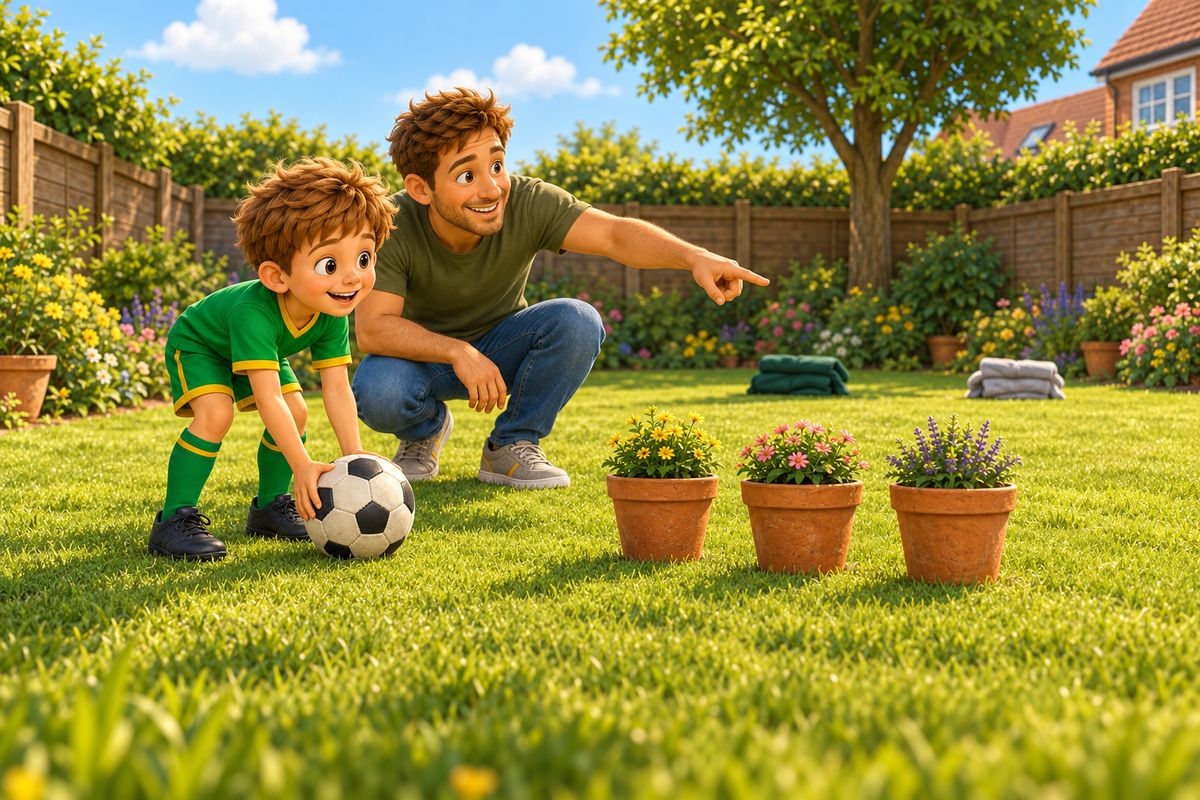
What the game does well
The game gives a child things a small garden often can't: instant restarts, a chosen star and tricks that work on the first press. It also has a table that remembers the score. None of that is a character flaw, because it is a well-made product doing its job.
These are my readings of why children choose it, and none has been tested as a cause for children aged 5 to 9. The nearest studies are surveys of older children and young people (a survey of 1,979 Finnish adolescents, a questionnaire study of young people aged 14 to 24).
| The game gives | The garden often lacks | A garden version |
|---|---|---|
| Instant restart after every goal | Waiting while the ball is fetched | Two balls on the lawn, so a restart takes two seconds. |
| Choosing your player | A character to be | Pick a "player" for tonight and a move they are famous for. No real player's name is needed. |
| Trick moves on one button | Moves that work first time | One easy move, tried ten times, counting the ones that come off. |
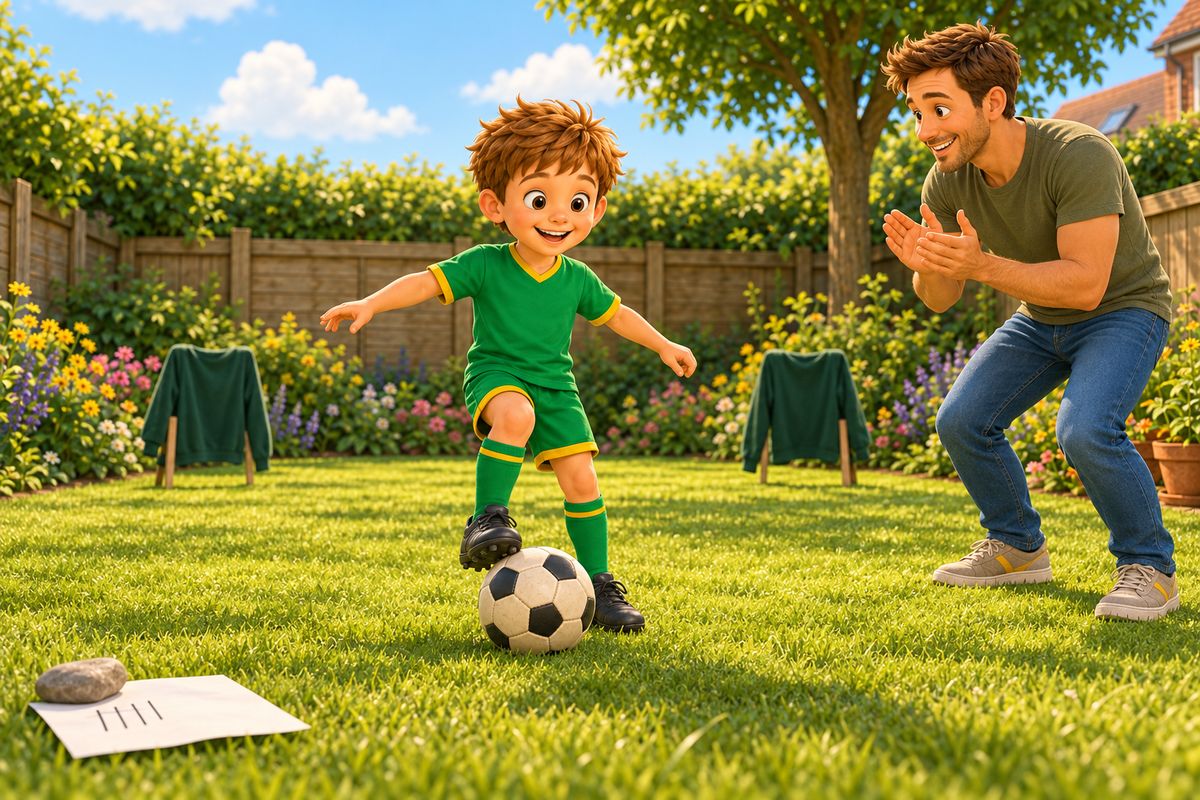
| Career mode and a league table | A running score | A tally on a scrap of paper that carries across the week. |
| Penalties and free kicks | Goals that matter | A target gap between two jumpers, three attempts each. |
| Goal replays | Someone watching | You, calling "replay!" and giving a slow-motion cheer. |
Pick one row a session, because a child given six challenges does none of them. The table is a spotting aid, and a shrug is a fair answer.
If your child is happy outside but you are the one narrating every touch, read stop coaching, start playing.
Five steps, one at a time
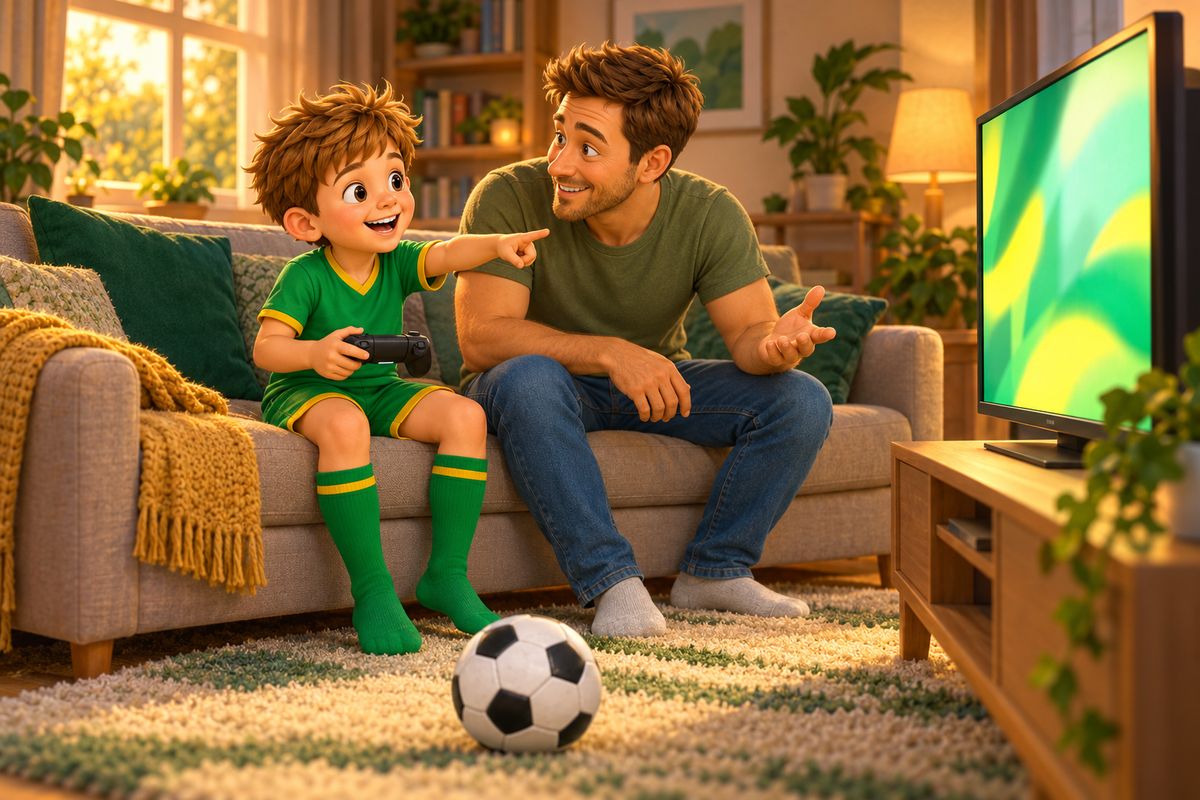
These steps are in my order, built on the idea that a child is more willing to try what they have chosen. No study tests them with children aged 5 to 9, and the surveys we do have cannot show that a game leads to more sport.
Keep each step to a few minutes in a garden or quiet park, with two jumpers or cones for a goal and one ball.
Be taught for five minutes. Ask your child to show you their best goal on the screen and say what each button does. Say little and ask real questions. Being the expert is the reward.
One move for real. Pick the simplest move you saw and try it outside, with a ball and no pressure. Count the ones that come off.
Rebuild a goal. Recreate one goal from the game with jumpers for posts. Your child directs where you stand, and you play the defender who gets beaten.
A week of career challenges. Three small tasks across the week, each under five minutes: a free kick, a dribble round two cones and a penalty. Tick them off on paper, like a league table.
Your child sets the next one. When the week is done, your child writes the next challenge. Ownership is a reward.
Move up a step when it still looks like fun. Step back, or stop, if the sulk returns, and call that normal.
Screens around a session have their own rules, and screens before or after football has a countdown that works. For finishing without a row, ending sessions without tantrums helps. None of this is a tested programme.
Ask, don't announce
A child told "that game is rubbish, go outside" hears an attack on something they love. A child who feels judged for liking it is less likely to show you, which is my reading and not a finding.
"Shall we do your best goal on the screen, then try one outside?" Ask before you start, and let a no be an answer.
"That one came off! Do it again?" Say it when a move works for real, with no comment on how it compared with the screen.
"Shall we do the rest of the league table tomorrow?" Stop on a good bit and keep the table for next time.
"Shall we show each other a trick, you on the screen and me in the garden?"
Try to stop saying "you're always on that thing", "when I was your age" and "that's not real football". None has been tested and all add pressure.
If your child says no three times, leave it for a few days and keep the invitation light.
Time, money and a label
The NHS asks children aged 5 to 18 for an average of at least 60 minutes of moderate or vigorous activity a day and to break up long periods of sitting (the NHS guidance on activity for ages 5 to 18). A kickabout counts, and so does a bike ride or a walk to school. I haven't set a number of hours for the console, because the NHS page doesn't either.
That is a population guideline, not a verdict on one child's evening.
On money, PEGI lists "In-game purchases" among the descriptors on its labels, extended to "In-game purchases (includes random items)" where random items are involved (PEGI's page on age ratings), so look for them on the box or store page. Checking the settings, password-protecting purchases and agreeing a spending cap before a child asks are my suggestions, not a tested rule. A commercial parents' guide to EA Sports FC advises keeping ages 7 to 10 away from Ultimate Team and in Career Mode or Kick-Off instead. It is a commercial guide, so treat it as one view.
On the label, PEGI says its rating "considers the age suitability of a game, not the level of difficulty" (PEGI's page on age ratings). A law firm's summary of the new PEGI rating criteria says new rules add checks on online and monetisation features, but I did not check its dates or scope against PEGI itself. Check the label on the box or store page for the edition your child has rather than assuming.
Pick a finish time before the game goes on. Staying in the room for the first ten minutes of online play is my suggestion, not a sourced rule.
What is known and what is not
The NHS says children aged 5 to 18 should aim for an average of at least 60 minutes of moderate or vigorous activity a day (the NHS guidance on activity for ages 5 to 18). It is population guidance, not a test of any bridge or of a game.
A survey of 1,979 Finnish adolescents aged 11 to 15 found that playing ball sport simulations like FIFA was associated with taking part in sport or activity on five or more days a week. It is an association measured at one time, self-reported, in children older than 5 to 9, so it cannot show the game causes activity. Sporty children may simply enjoy both.
A questionnaire study of young people aged 14 to 24 in China linked e-sports game experience with a higher intention to take part in sport. Intention is not behaviour, the ages are older and the authors note they could not fully control for game type and playing time.
A coaching blog concedes that time spent playing outside is "vastly more beneficial" than the game (a coaching blog that rates time outside higher). A coaching site suggests swapping the console for a real session (a coaching site's advice on swapping the console for football). Both are blogs, not studies, and the second sells coaching.
PEGI's page on age ratings says its rating covers age suitability rather than difficulty and lists "In-game purchases" among its descriptors, extended to "In-game purchases (includes random items)" where random items are involved. It gives no advice on how much a child should spend or how to supervise online play, so those suggestions here are mine.
No study I found tests a bridge, a script or a translation table for children aged 5 to 9 who prefer the game. I would rather say the five steps are a sensible default than pretend a study picked them.
Quick answers
The game gives instant restarts, tricks that work first time and a table that remembers the score, which a garden often can't. That is my reading, not a tested finding.
Not proven. Surveys of older children and young people link sports games with more sport, but they show association, not cause, and a coaching blog still rates time outside as more beneficial.
Ask to be taught, try one move outside, rebuild a goal and run a few small challenges across the week. Keep each to five minutes.
The NHS page sets an activity goal of an average of 60 minutes a day for ages 5 to 18 and no number of screen hours. Agree a finish time first and protect the activity.
Password-protect purchases and agree a cap before your child asks. A commercial guide suggests keeping ages 7 to 10 away from Ultimate Team. Check the age label for the edition you own, which can list in-game purchases, including random items.
Leave it for a few days and keep the invitation light. There is no deadline, and nothing I found says how many tries are right.
Keep going
Three places to go next, depending on what you saw.
Two different rules for before and after football, with a script that holds on a tired evening.
Read about screens and footballShort bursts and a few things to point out, and an honest answer on whether it helps.
Read about watching togetherMore ways to match football to the way your child likes to play.
See Parent Play StyleTonight's five minutes
Sit with your child and ask to be shown their best goal on the screen. Then try one move from it outside with a ball and two jumpers. Stop on a good bit.