Pulls them off after two minutes?
The usual reasons a child refuses them and one fix for each.
Read about refusing shin pads
Measure first, then read the chart.
Age on the packet is only a rough guide, and two brands can put the same child in different sizes, so a two-minute measure saves buying twice.
So, what size shin pads for kids? Size them by height or shin length first and by the age on the packet second. Measure from just below the knee to the ankle bone, then read across a chart, because brands differ (Nike UK's kids' shinguard size guide, a children's football retailer's size guide).
The pads should be covered by the sock and sit snug without sliding when your child walks. The Laws of the Game require shinguards to be "covered by the socks" and made of a suitable material. They say nothing about size, so the fit is down to you (Law 4 of the Laws of the Game). Check again each season, because a growth spurt can outpace a pair in a few months.
See Kit, Rules & Safety for the rest of the kit bag.
Height, age and shin length
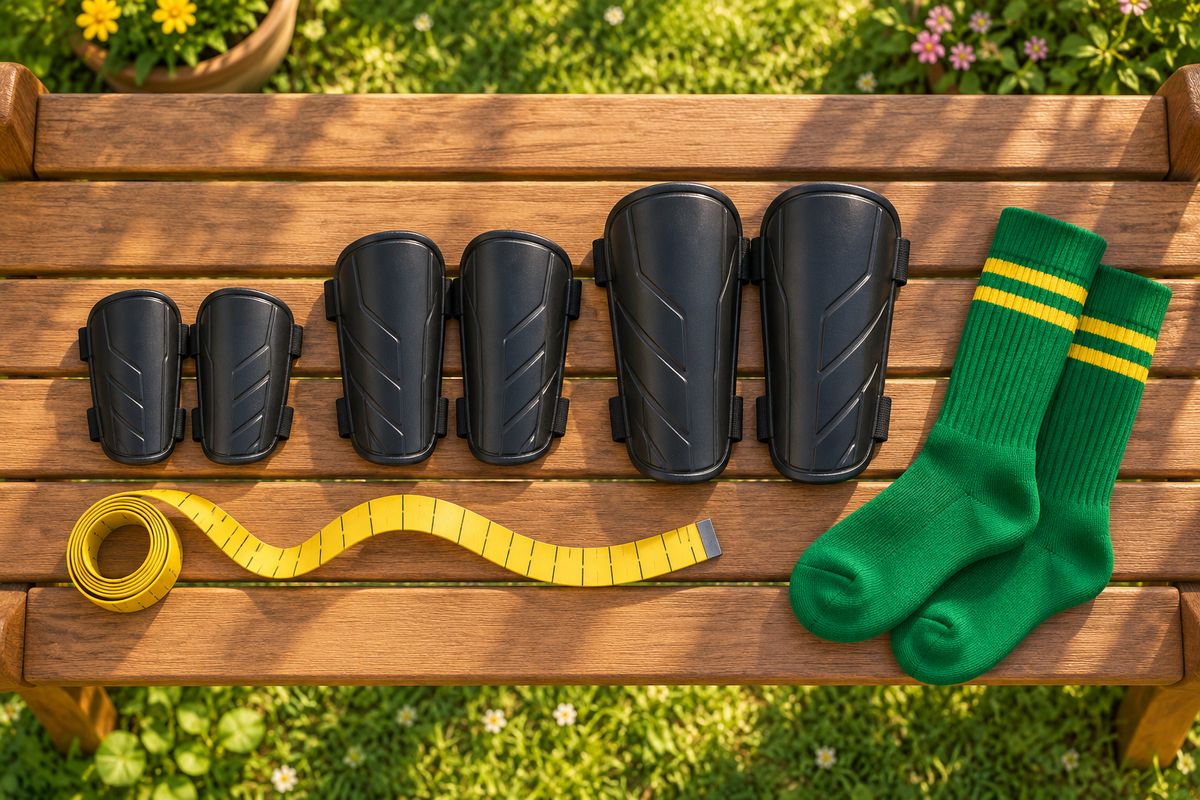
The table below sets two named retailers' charts next to each other. They are not a standard, and where they overlap is the useful part.
| Size band | Nike UK (height, age) | childrensfootball.com (shin length, age) | Overlap note |
|---|---|---|---|
| Smallest | S: 48 to 51 in (about 122 to 130 cm), age 4 to 6 (Nike UK) | XS: 6 to 8 in (about 15 to 20 cm), age 2 to 5 (retailer chart) | Nike prints age 4 to 6 against a height band taller than many children of that age, so go by height or shin length, not the age label. A child under about 122 cm may sit below Nike's smallest size. |
| Small to medium | M: 51 to 55 in (about 130 to 140 cm), age 7 to 9 | S: 8 to 10 in (about 20 to 25 cm), age 4 to 9 | Most young beginners sit in this row, so measure the shin. |
| Larger | L: 55 to 59 in (about 140 to 150 cm), age 10 to 12 | M: 10 to 11.5 in (about 25 to 29 cm), age 8 to 14 | Children at the top of the age band may need this row. |
The centimetre figures are my own conversions from inches (1 inch is 2.54 cm), so check them against the live chart. The age bands are the retailers' labels and not a guide to any one child.
Sizes differ by brand, so the chart for the pair you buy beats this one. Children at the younger end of a band often fit the smaller size (a children's football retailer's size guide).
There is no law on shin pads for garden play. The Law 4 wording applies to matches (Law 4 of the Laws of the Game).
Two minutes, one soft tape
I once bought a pair by the age on the packet. They sat halfway down the shin and slid to the ankle by the first corner.
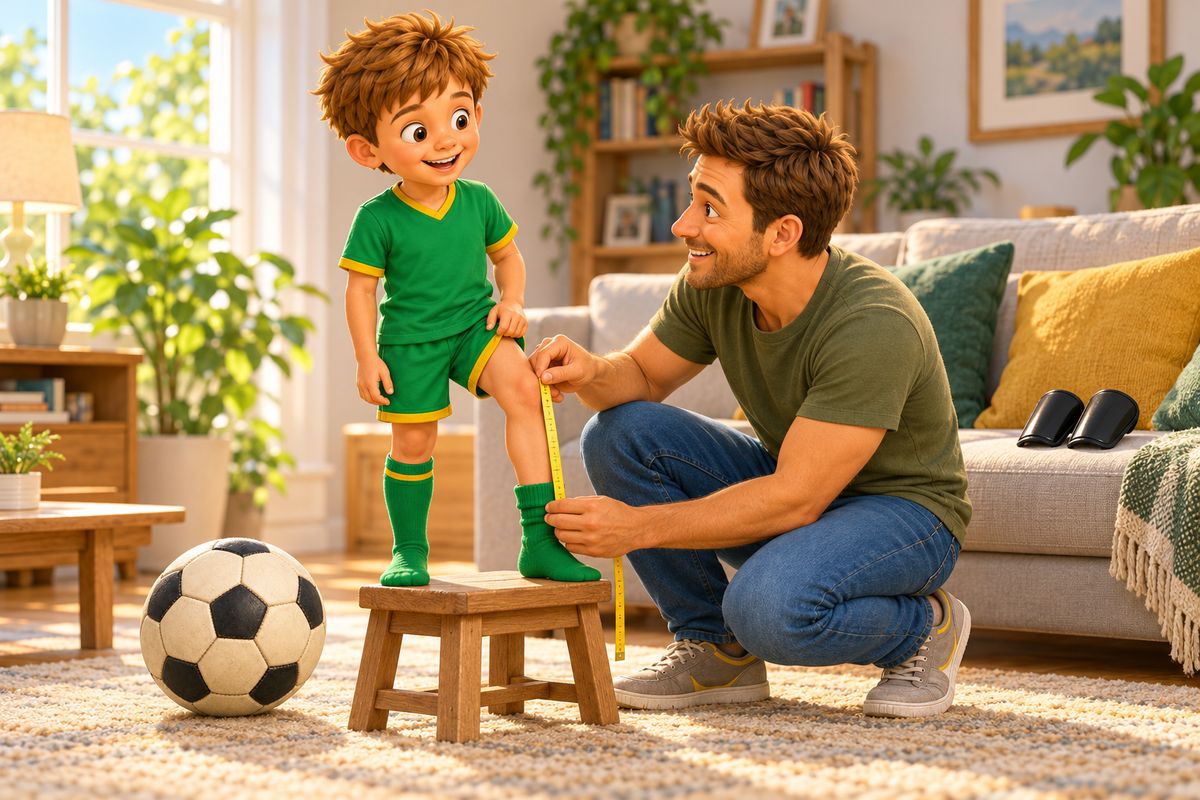
This is a practical method, not a rule from a governing body or a retailer. The charts say which measurement they use but not how to take it. A soft tape from a sewing kit works well.
Stand them up. Barefoot on a hard floor, knees straight.
Measure the shin. A soft tape from just below the knee to the ankle bone.
Read across. Match the number to the size band on the chart for the pair you are buying.
Choose by the fit test. If your number falls between two bands, try the smaller first. Take the larger only if the smaller leaves the lower shin uncovered, then check the fit.
Here is a worked example with a made-up number, not any child's measurement. A shin of 23 cm sits in the 20 to 25 cm band on the retailer chart, so that points to a small.
Height gives a second opinion. If the chart you are using is by height, as Nike's is, measure that too and see whether the two agree (Nike UK's kids' shinguard size guide).
Three checks in the hallway
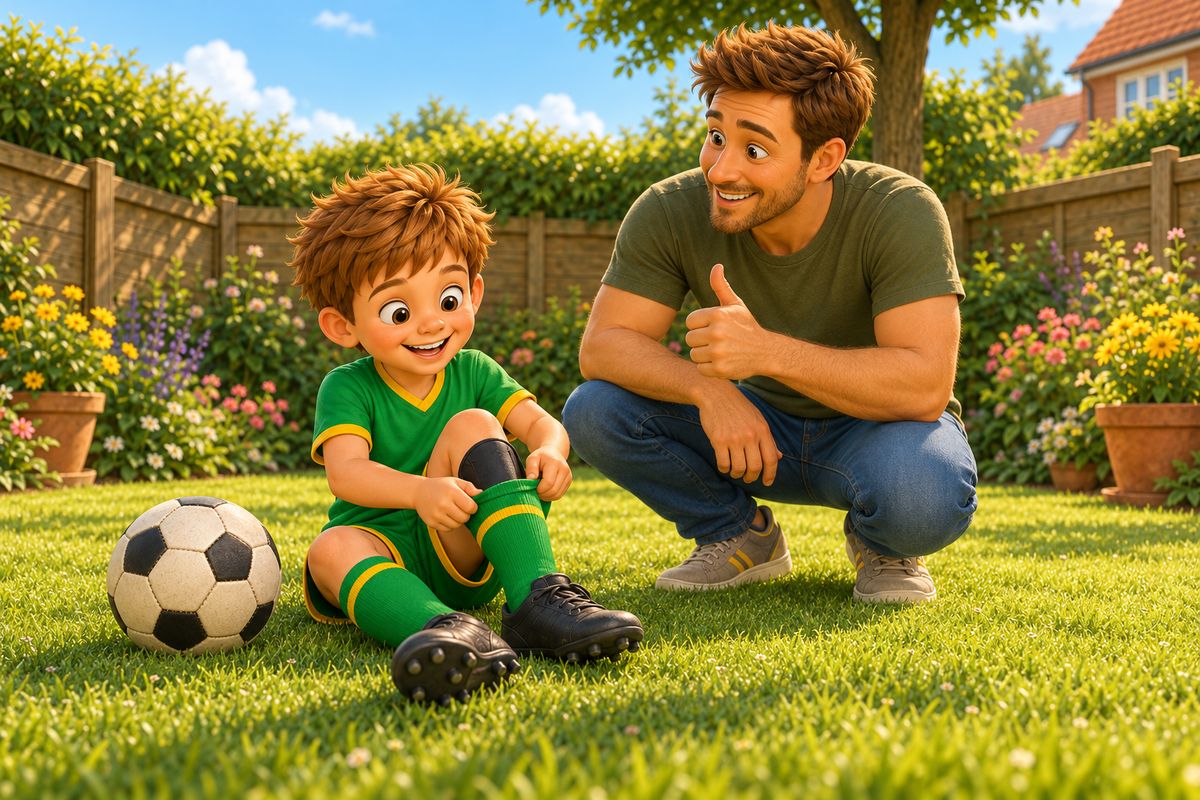
Try the pads on with the sock over the top, then walk the length of the hallway. Three quick checks tell you most of what you need.
Put the sock over the pad. The Laws require shinguards to be "covered by the socks" (Law 4 of the Laws of the Game).
It should not slide when your child walks or jumps on the spot. If it drops, it is too big or the wrong shape.
It should not press behind the knee or rub the ankle bone when they bend.
Check the fit every season and after any visible growth spurt. A pad that reaches the knee crease or slides is done.
If the right size still gets pulled off, see child refuses to wear shin pads. Boots are the other piece of kit worth sizing now, so see choosing first football boots.
Fit for now, checked often
I used to think buying a size up was the thrifty choice. A loose pad slides off the shin and may protect very little.
Buy the right size now and expect to replace the pair as your child grows. That is cheaper than a pair that gets pulled off and left in the boot bag.
Choose a style that stays put, such as a slip-in sleeve or an ankle-guard design. Try them on in the shop, or at home with the tags still on if the returns policy allows.
Size 3 or 4 is a similar question for the ball, so see what size football for kids.
What is known and what is not
Law 4 of the Laws of the Game lists shinguards as compulsory equipment, to be "made of a suitable material to provide reasonable protection and be covered by the socks". It does not say anything about size.
Nike's chart sizes by height, while the retailer chart sizes by shin length. Their age ranges overlap, which is why a child can sit between two sizes.
These are a governing body's wording and two retailers' charts, not a study of fit or injury, so they cannot tell you which size is safest for your child. Retailer charts are commercial and can change, and the measuring method, the snug-fit check and the replace-when advice here are practical advice with no source behind them. Only the covered-by-the-sock check rests on Law 4.
Quick answers
Measure the shin from just below the knee to the ankle bone and read across the chart for the pair you are buying. Height is the other guide (Nike UK, retailer chart).
Charts label Nike S as 4 to 6 years and a retailer's XS and S as 2 to 5 and 4 to 9 years. Nike sizes by height and the retailer by shin length, so an age label does not settle it. Measure the shin: most young beginners sit in the retailer's S row (20 to 25 cm), and a shorter shin points to XS (Nike UK, retailer chart).
Covered by the sock, as Law 4 requires (Law 4), and snug and not sliding when your child walks.
No. A loose pad can slide and protect less. Buy for the shin as it is now, taking the larger size only when your measure falls between two bands and the smaller does not cover, and check each season.
No law applies at home, and Law 4 covers matches (Law 4). Pads are a choice for park or club play.
When they reach the knee crease, slide or rub, which usually follows a growth spurt.
Keep going
Three places to go next, depending on what you found.
The usual reasons a child refuses them and one fix for each.
Read about refusing shin padsAstro or firm ground, fit and sizing for a first pair.
Read about first bootsSize 3 or 4, and when to move up.
Read about ball sizesTonight's five minutes
Take a soft tape, measure from below the knee to the ankle bone and write the number on your phone. Then read it across the chart for the pair you want.