Worried it is more than clumsy?
Adapt the same games for a child with specific sensitivities or a diagnosis.
See adapted games
Clumsy is not the same as unable.
If your clumsy child is learning football, the job is a calm read of what you see, a few minutes of slow movement play and words that take the pressure off.
For a long time I picked the ball up the moment my child tripped over it, as if taking it away would take the trip away. The trip was never the problem. The problem was the glance at the other children afterwards.
Match tonight's worry to a row
If your clumsy child is learning football, start with movement, not the ball. A few minutes of walking, stopping and stepping, then slow and soft play with the ball last, gives a child more chances to feel steady, and some children are just less coordinated than others (an occupational therapist's article on clumsiness).
Clumsy is a broad word, and a tripping child, a flailing child and a child who goes quiet each need something different. The NHS describes coordination difficulty as a child who performs "less well than expected in daily activities for their age" and may "appear to move clumsily" (the NHS page on developmental co-ordination disorder (dyspraxia) in children). It says nothing about football, so the table below is my reading of ordinary advice, not a tested checklist (an occupational therapist's article on clumsiness, an NHS trust's ball-skills advice).
| What you see | What it may mean | What to try this week | What to say |
|---|---|---|---|
| Trips over their own feet when running or turning | Feet and body are still learning to work together, often worse when rushed or tired. | Slow it down: walk, turn and stop on flat grass in laced shoes, as in the opener below. | "Slow and steady wins this one." |
| Trips over the ball | Eyes locked on the ball while the feet are forgotten, or the ball is moving too fast. | Start with a ball at rest and walk beside it, with no run-up and no kick. | "Walk it to the tree with me." |
| Arms stiff or flapping when something comes at them | Unsure what is coming and when. | Use slow, soft, light things and say "ready" before each one (NHS trust). | "I'll say ready first." |
| Drops or misses catches | Timing is hard when an object is fast or small. | A large ball first, rolled, then bounced to the front or side (NHS trust). | "That one was quick. Shall I send a slow one?" |
| Hangs back, goes quiet, stays at the edge | May feel watched, or has noticed the comparison. | Play just the two of you first, for two minutes, and let your child choose the game. | "Shall we try it just us first?" |
| Gets cross, says "I'm rubbish" or avoids it | Frustration or lost confidence. The NHS lists avoiding joining in as one of many signs (NHS symptoms). | Stop on a good moment and keep it short. | "That looked hard. Two minutes, then we stop." |
Pick one row per session, because a child told five things stops listening. One row on its own is not a sign of anything, and the "what it may mean" column is my reading, not a finding.
If the gap you see is size rather than coordination, see child smaller than other kids at football.
Three minutes, no ball yet
England Football tells coaches of players aged 5 to 11 to focus on agility, balance and coordination, using tag, dodge and chase games (England Football's article on movement skills). The UK Chief Medical Officers list play, walking, running, skipping and climbing among activities that develop coordination (the UK Chief Medical Officers' guidance for 5 to 18 year olds). There is no study of this opener for children with weaker coordination, so it is my order, not a tested one.
Walk and freeze. Walk round the garden together. Call "freeze" and both of you stop dead, like statues. Walking first means no tripping at speed.
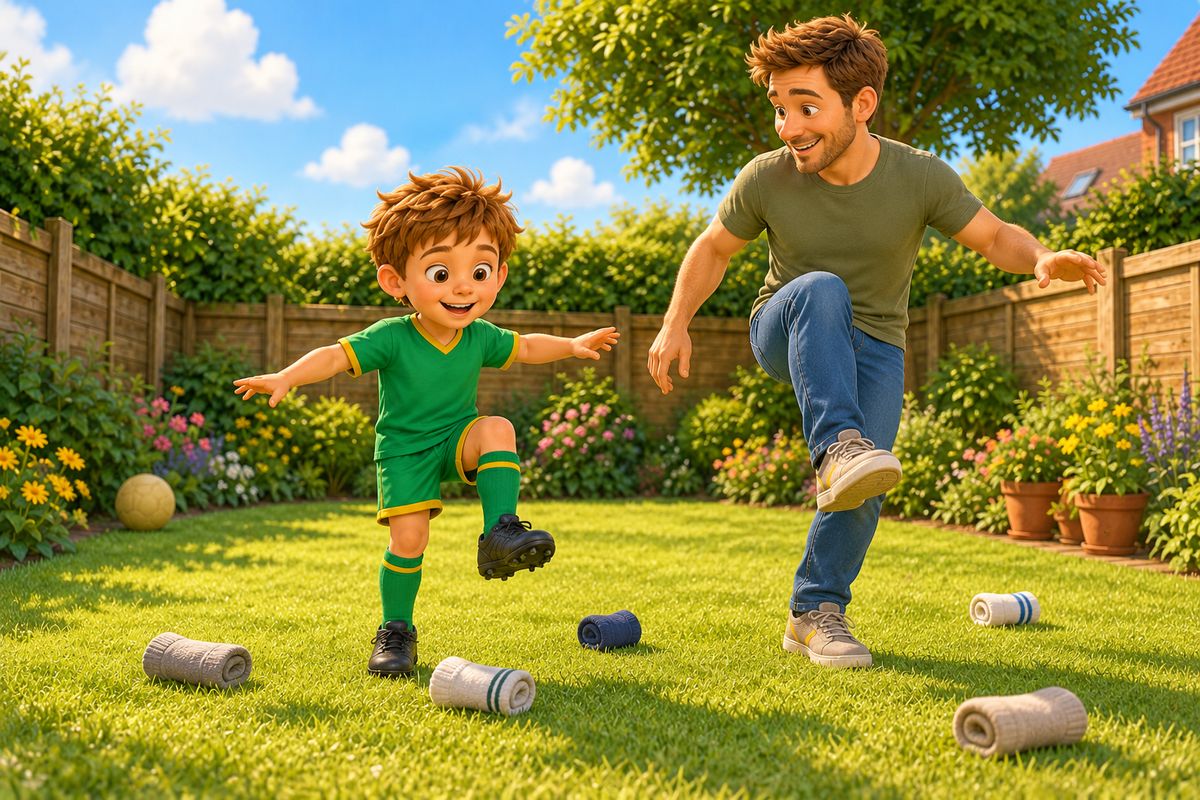
Puddle steps. Roll up a few socks and scatter them as puddles. Step over each one, big slow steps, grown-up too. Hands can touch the fence if a wobble comes.
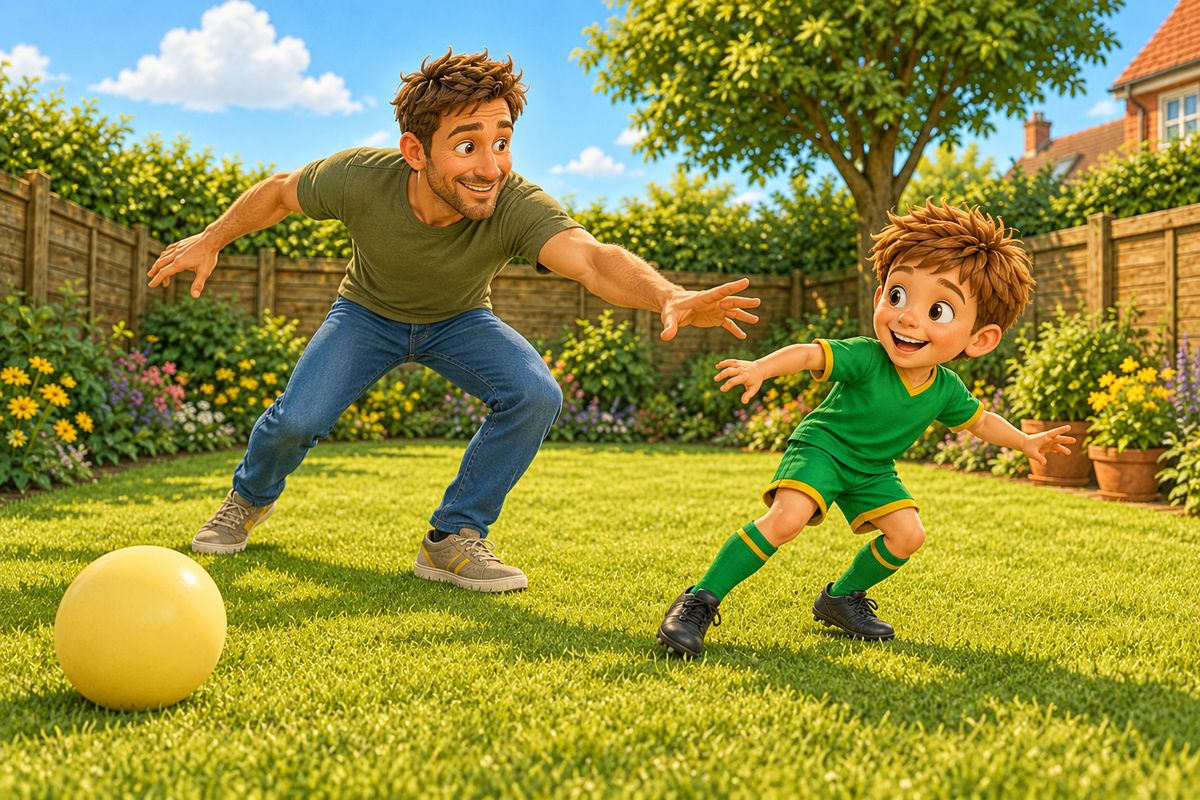
Slow-motion tag. Tag in slow motion, as if underwater. Slow tag keeps the body in control, and it is the dodge-and-chase idea from England Football with the speed turned right down.
The ball, last. Roll or carry a big soft ball beside you and walk it to a tree with the inside of the foot. Stop after one walk if it went well.
Three minutes is enough. Stop on a good moment, and if your child asks for more, give one extra go, not ten.
For a silly start that gets a reluctant child moving, see a parent and child warm-up game. Nothing here is a tested programme.
Slow things are easier to read
An NHS trust's ball-skills advice suggests starting with a large ball and building to smaller balls over longer distances, with bounces to the front and side to practise anticipating. No study I found shows these games help a clumsy child in football.
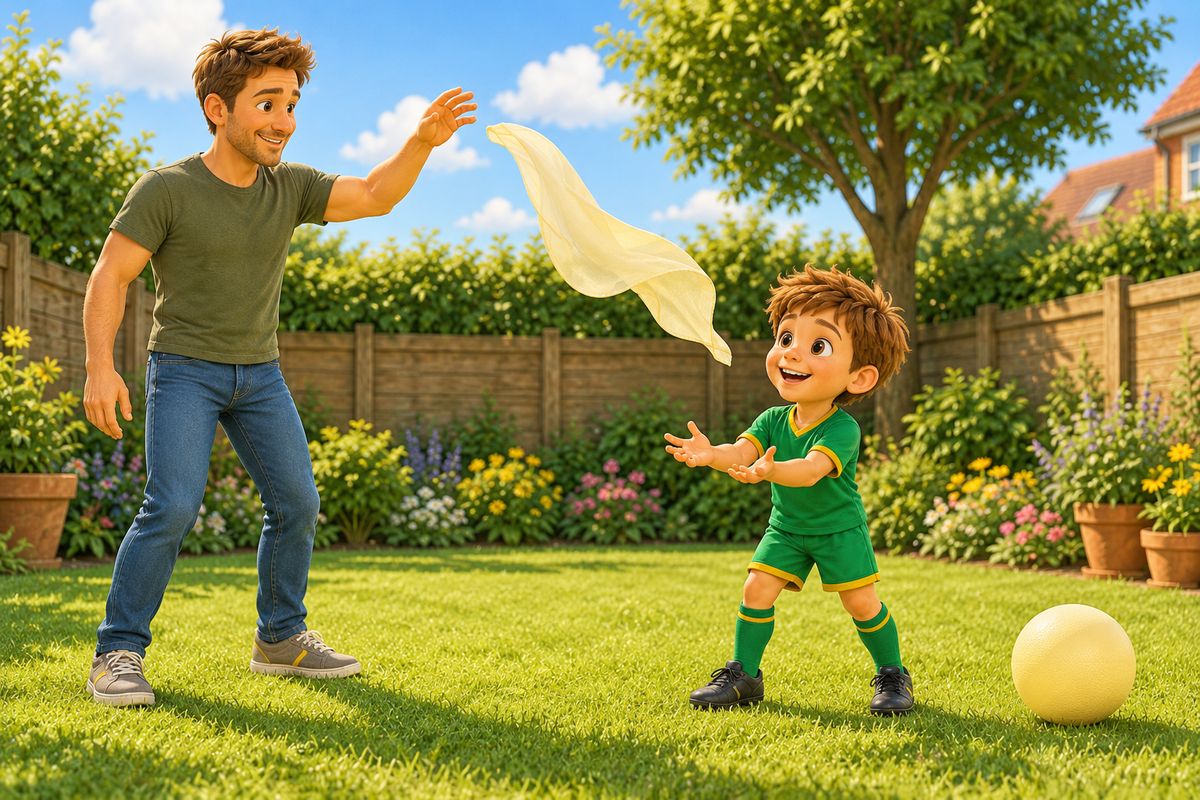
For tracking. Throw a light scarf up so it floats down slowly. Your child lets it land on a hand, then a foot, and counts "caught" for any touch. A falling scarf gives the eyes more time.
For anticipation. Sit a few steps apart. Roll a big soft ball slowly and let your child stop it with both hands, then both feet. Vary the roll a little to one side now and then.
For rhythm. Walk beside a big soft ball and nudge it with the side of the foot every other step towards a tree. Count steps out loud so there is a beat. The point is a steady rhythm, not power.
A balloon is the gentlest soft object of all, and balloon football games has three more. If a game gets frantic or your child starts to look at you for rescue, go back to slow motion.
What to say, and how to read your own worry
Children notice the comparison before you do. Keep the first sessions to the two of you, for two minutes, and end on a good moment.
Praise the doing ("you kept going") rather than the result ("you caught it"), because a child's belief in their own ability seems to go with how much they join in. In a school survey of 590 children, children with probable coordination difficulty did less physical activity, and lower belief in their own ability partly explained it. It shows a link, not that praise changes it.
"That was a hard one and you kept going."
Then read your own worry. Is my child bothered, or am I? Did something happen, such as a comment from a friend? Would I be this worried if this were swimming or drawing?
Some children are simply less coordinated than others without a significant problem (an occupational therapist's article on clumsiness).
For the words themselves, see what to say during play and praise phrases for football. If your child has started to say they want to stop, start with child wants to quit football.
A calm signpost, not a diagnosis
Most clumsy children are just learning, and an article cannot tell a child who needs a closer look from one who does not. The NHS describes developmental co-ordination disorder (dyspraxia) as "a condition affecting physical co-ordination", and says a definite diagnosis does not usually happen until a child is 5 or more (the NHS page on developmental co-ordination disorder (dyspraxia) in children).
Its symptom list for older children includes "hopping, jumping, running, and catching or kicking a ball", and says children may bump into objects, drop things, "fall over a lot" and avoid joining in (the NHS symptoms list for older children).
A plain reading, and mine rather than the NHS's, is to mention it in three cases. One is when the same difficulty shows up in several everyday places such as stairs, dressing or writing as well as games. Another is when your child is upset or avoids PE and playground games, and the third is when weeks of easy practice make no change. Mention it to a GP, health visitor, school nurse or the school's SENCO, as the NHS suggests (NHS, NHS diagnosis page).
An NHS trust's ball-skills advice gives one rule of thumb for ball skills: speak to a health visitor or GP if you are still not seeing any improvement after four months of its techniques. A children's mental health charity's guide to dyspraxia says to look for help when coordination issues interfere with "schoolwork, play and getting dressed".
Asking is not a label. An assessment is done by a paediatrician, often with occupational therapists (the NHS page on how DCD is assessed), and football alone is rarely the whole picture either way.
If your child already has a diagnosis, see football games for a child with additional needs. The NHS pages do not mention football or say how many trips or drops matter, so there is no number to give.
What is known and what is not
A school survey of 590 children in grades 4 to 8 found that, among children with probable coordination difficulty, belief in their own ability partly explained doing less physical activity. It is one cross-sectional survey in Canada of older children, it shows a link and not a cause, and it tests no game or phrase.
The NHS pages describe the difficulty and who to ask (the NHS page on developmental co-ordination disorder (dyspraxia) in children, the NHS symptoms list for older children, the NHS page on how DCD is assessed). They are about a diagnosis, not football, and give no number.
The UK Chief Medical Officers say an average of at least 60 minutes a day across the week and name play and climbing among activities that develop movement skills. That is guidance for all children, not for clumsy ones. England Football lists agility, balance and coordination as the focus for ages 5 to 11, but it is guidance for adults running sessions and no drill was tested.
An NHS trust's ball-skills advice and an occupational therapist's article on clumsiness add practice advice and one clinician's experience, nothing more.
No study I found tests a movement-first opener, a slow game or a kind phrase for a child with weaker coordination who is learning football. I would rather say the opener is a sensible default than pretend a study picked it. For the medical side, start with the NHS page on developmental co-ordination disorder (dyspraxia) in children.
Quick answers
Often, yes. Some children are just less coordinated than others without a significant problem (occupational therapist). If it shows up in several everyday places or your child avoids games, talk to a GP, health visitor or school (NHS, NHS symptoms).
It may be that the eyes are fixed on the ball while the feet are forgotten, or the ball is moving too fast. This is an untested reading. Try a ball at rest and walk beside it with no run-up.
Slow and soft ones: walk and freeze, stepping over socks, Scarf Catch and Roll and Catch. England Football recommends agility, balance and coordination games for ages 5 to 11 (England Football's article on movement skills). No study tests these games for clumsy children.
No source I found names one best sport. The UK Chief Medical Officers say an average of at least 60 minutes of activity a day across the week and list many types, including play and climbing (the UK Chief Medical Officers' guidance for 5 to 18 year olds). Pick what your child enjoys.
Ask first whether your child is bothered or you are. A school survey of 590 children found belief in their own ability partly explained how much children with probable coordination difficulty joined in. Keep it kind, and ask a GP if you are still worried.
There is no single number. One NHS trust suggests speaking to a health visitor or GP if you see no improvement after four months of its ball-skills techniques. Ask sooner if your child is upset or avoiding games.
Keep going
Three places to go next, depending on what you saw.
Adapt the same games for a child with specific sensitivities or a diagnosis.
See adapted gamesWhat to do when a child says they want to stop.
Read about wanting to quitMore calm, low-pressure ways in for a child finding their feet.
See Confident BeginnersTonight's five minutes
Roll up a few socks and scatter them on dry grass. Walk round together, freeze on a call and step over each puddle slowly. Stop after three minutes, on a good moment, and say what went well.