Does your child only want to be in goal?
A one-position habit is usually fine, and there is a gentle way to open the door.
See the goalkeeper habit
Nobody ever told your child defending was the fun part.
If your child hates defending in football, the fix is to make winning the ball score, so the defender gets a turn at the exciting bit.
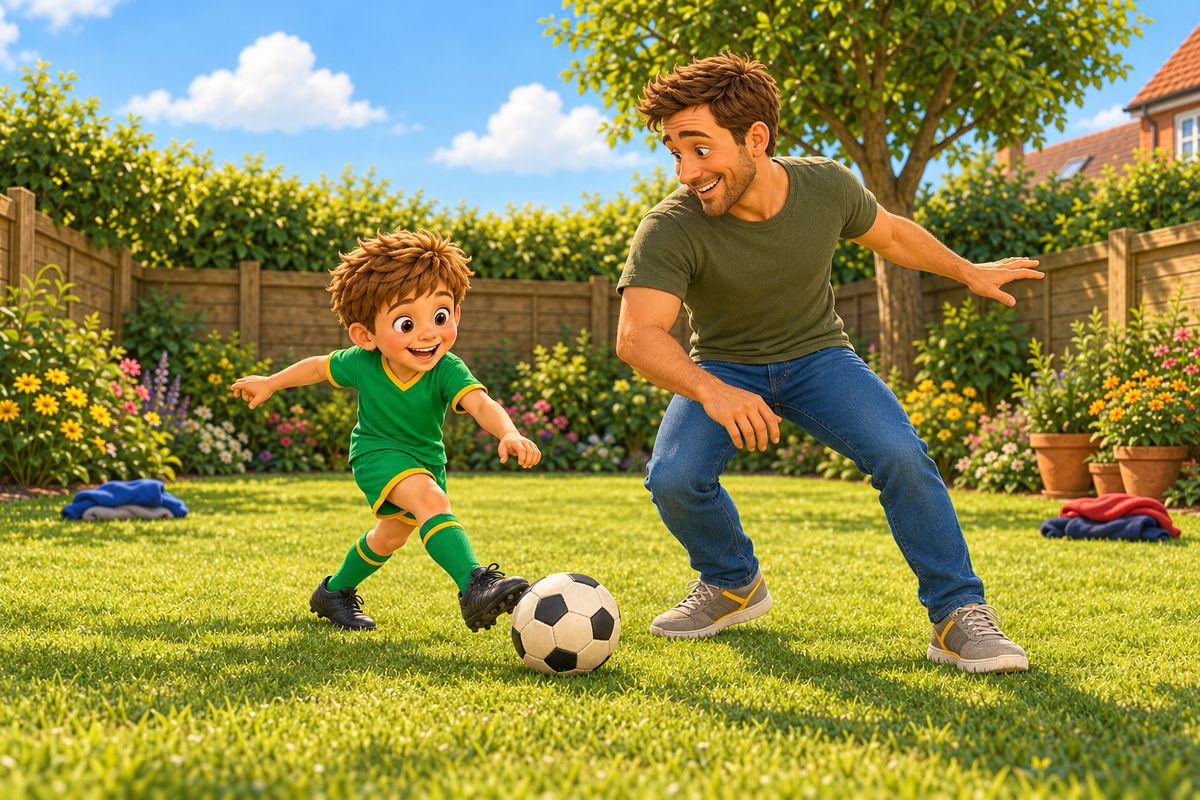
For a long time I called "get back!" from the patio, and all it produced was a child standing by the fence looking at me. Then I made winning the ball worth a point. The same child chased down a ball I had not even asked about.
Watch two minutes first
If your child hates defending, defending usually feels like waiting: no ball, no goals, nothing to chase. Make winning the ball worth a point, let the ball-winner start the next attack and swap roles after every goal, and nothing needs a real tackle.
At this age it is fine for a child to rotate roles, and England Football's new small formats are built so every child both attacks and stops goals (England Football's 3v3 format for under 7s). If the fun has gone, stop and try another day.
In a garden game the defender spends most of the time waiting with nothing to do, while the child with the ball gets every touch and every goal. For a child that is the least fun job. The reasons below are readings, drawn from what coaches and parents describe (a coaching blog on a child who hates defending, a parenting article on a child who does not want to play). None has been tested as a cause in children aged 5 to 9.
| What you see | What it may be | First thing to try |
|---|---|---|
| The child drifts upfield the moment the ball is lost | Defending feels like not playing, with no ball and no goal | Rung 1: winning the ball scores a point |
| The child backs off instead of closing in | A worry about being dribbled past or looking silly | Start at rung 1, then rung 4: you leave the ball a little too easy to win |
| The child only plays if they can score | Goals are the only reward on offer | Rungs 1 and 2: winning the ball earns a point and a free attack |
| The child sulks or goes quiet at "get back!" | Pressure from the sideline has turned a job into a telling-off | Stop saying it and use the scripts below (a study of 321 children aged 10 to 16) |
| The child flinches when the ball is contested | It may be the bump, not the job | Skip tackles entirely: they win the ball by a touch only, as in the ladder below, and the page on contact worries is linked under the table |
| The child heads for goal every game | It may be a one-position habit, not a dislike of defending | Swap roles after every goal (rung 3 of the ladder below), and the page on goalkeeper habits is linked under the table |
Pick one row per session, because a child given six fixes gets none of them. The table is a spotting aid, not a diagnosis, and a shrug is a fair answer.
If the worry is about being bumped, see child afraid of contact in football. If your child always heads for goal, see when your child only wants to play goalkeeper.
Five rungs, one at a time

The ladder is built from The FA's advice to "give a real purpose for getting the ball" and to show that getting it back "can be fun, enjoyable and a way to start attacks and score goals". That advice is set out in The FA's guidance on defending for ages 5 to 11. Points are my own reasoning. It is a sensible default, not a tested method, and there are no real tackles and no sliding at any rung.
Set two jumpers or cones as a gate at each end of a patch of dry grass, with one grown-up and one child, in a garden or a quiet corner of a park.
Winning the ball scores. Any time your child gets a foot to the ball when you have it, count it as 1 point, said aloud. A goal is also 1 point. Winning the ball is now as good as scoring.
The ball-winner starts the attack. When your child wins the ball it is their ball to run at your gate, with you stepping aside. Defending now ends in the attack they wanted.
Roles swap after every goal. Whoever scores becomes the defender. Defending is a turn that comes round, not a position they are stuck in.
You defend beatably. Leave the ball a little too far and slow down. Winning it should feel earned and easy; see playing defender against your own child for how to stay beatable without it feeling fake.
The ball-winner picks the next game. When your child wins the ball three times, they choose the next game or the next gate. A little say is a reward.
Start at rung 1, or at the rung a table row points to. Move up a rung when winning the ball starts to look fun. Move back a rung, or stop, if your child goes quiet, and call it normal.
For a child who tenses when you get close, the gentlest start is to mirror your child without ever reaching for the ball, which is the shadow defending method. Nothing here is a tested programme. In a park, put the gates well away from paths, dogs and other families.
Say less, say it kindly
A child who hears "get back!" five times stops hearing it. Children who feel pushed may also enjoy sport less: a study of 321 children aged 10 to 16 linked parental pressure with lower satisfaction of children's basic psychological needs, and that with less enjoyment. It is an association and not proof.
"Shall we play a game where winning the ball scores a point?" Ask before you start, and let the answer be no.
"That was a win! One point." Say it when a foot touches the ball, with no comment about where anyone was standing. Praise the attempt, not the result.
"Shall we swap, so you attack and I defend?" Finish on a swap and stop on a good moment.
"Shall we make defending the quick part and attacking the long part?"
Drop "get back", "defend!", "stop being lazy" and comparisons with a sibling or a professional. None of them has been tested and all of them add pressure.

If your child has already said no, ask once, lightly, away from football, why, and accept "I don't know" (a coaching blog on a child who hates defending).
Fine to rotate, fine to wait
At this age rotating roles is normal, and a child who only wants to score is not broken. From the 2026/27 season England Football lists under 7s at 3v3 with no goalkeeper and under 8s and 9s at 5v5 (England Football's 3v3 format for under 7s, England Football's guide to game formats, published 2022 and updated 2025). Its own words are that 3v3 "creates more chances to learn, play, make decisions, score and stop goals".
That describes how the games are built, not how a particular child feels about defending, and England Football does not say rotation is required. Some coaching sites read FA guidance as encouraging children to try several positions through their youth (a coaching site's view on trying several positions), which is a coaching blog's reading, not a rule.
Hold off if your child is upset, tired or has had a rough week. Hold off if the fun has gone from the whole game, not just defending. Hold off if you are the one more bothered than they are (a parenting article on a child who does not want to play).
Give it a few goes, in short bursts, then leave it for a week. Coming back to it later is not giving in. No study found tests when to stop or how many tries are right, so this is a reading of parenting advice.
What is known and what is not
The FA's guidance for the foundation phase (ages 5 to 11) says to introduce defending enjoyably and "give a real purpose for getting the ball" (The FA's guidance on defending for ages 5 to 11). It is coaching guidance for adults who run groups, not a trial, and nothing in it covers a child who refuses.
England Football's formats for 2026/27 are 3v3 for under 7s and 5v5 for under 8s and 9s, designed so every child plays (England Football's 3v3 format for under 7s, England Football's guide to game formats, published 2022 and updated 2025). That is a description of design, with no test of how children feel about defending.
A study of 321 children aged 10 to 16 and their parents found parental pressure was linked with lower satisfaction of children's basic psychological needs, and need satisfaction with more enjoyment. It is an association measured at one time, based on children's perceptions, in children older than yours.
A study of what makes youth soccer fun gathered views from 142 youth soccer players, 37 coaches and 57 parents and found fun is built from many things, with children giving it as their main reason for playing. That is what people say is fun, not a test of defending games, and the players' ages were not stated in the record read.
A small study of role rotation in older players followed 24 older, highly trained players and found defensive roles were the most physically demanding in a rotating small-sided game. That defending might feel like hard work to a child is a guess, not a finding.
No study found tests a reward ladder, a role swap or a script for children aged 5 to 9 who dislike defending. I would rather say the ladder is a sensible default than pretend a study picked it.
Quick answers
Defending often means waiting with no ball and no goals, so it can feel like not playing. That is a reading of coaching and parenting advice, not a tested finding (The FA, coaching blog, parenting article).
Pushing tends to backfire. One study of 321 children aged 10 to 16 linked parental pressure with lower satisfaction of basic needs and with less enjoyment, and it is an association, not proof (the study). Try the ladder, then leave it for a week.
Make winning the ball score a point and let the ball-winner start the next attack (The FA). Swap roles after every goal and keep it to a few minutes.
At this age, usually not. Games for under 7s are 3v3 and for under 8s and 9s 5v5 from 2026/27, so children both attack and stop goals (3v3, formats, updated 2025). Rotating roles is normal.
Tell the coach calmly and ask whether roles can rotate. Nothing found says rotation is required, so ask rather than insist (3v3, formats, updated 2025).
Two to five minutes is plenty. Stop on a good moment and count the wins, not the misses.
Keep going
Three places to go next, depending on what you saw. Some children simply need to try every position first, and what football position suits your child shows how.
A one-position habit is usually fine, and there is a gentle way to open the door.
See the goalkeeper habitMirror your child without ever reaching for the ball, for a child who tenses up.
Try shadow defendingMore calm, practical help for the grown-up on the touchline and in the garden.
See Parent Play StyleTonight's five minutes
Set two gates on the lawn and tell your child that winning the ball scores. Count it out loud, let the ball-winner run at your gate and swap roles after every goal. Stop when it is still fun.